Home Blog Page 303

The Brain-Gut Connection for Mental Well-being

Have you ever wondered the reason behind feeling butterflies in your stomach? Or that sinking premonition feeling around your stomach when something unexpected happens?

Several studies over the years have established the brain-gut connection, and the condition of our gut influences one’s mental health. Human body consists of two brains. One is located in our head and the second one – in our guts, both these brains start forming at the time of fertilization.

They develop from the same cluster of tissue, wherein one section evolves into a central nervous system (brain) and another one into enteric nervous system (gut). Vagus Nerve, longest of all the cranial nerves, connects both these nervous systems.

Chemicals (hormones, neurotransmitters) that control the brain in the head are found in the gut brain as well. Due to this linkage between the brain and gut, researchers have concluded that a healthy gut helps in maintaining good mental and emotional health.

“Many of the gut signals reaching the brain will not only generate gut sensations, such as the fullness after a nice meal, nausea and discomfort, and feelings of well-being, but will also trigger responses of the brain that it sends back to the gut, generating distinct gut reactions. And the brain doesn’t forget about these feelings, either. Gut feelings are stored in vast databases in the brain, which can later be accessed when making decisions.” ~ Emeran Mayer, The Mind-Gut Connection: How the Hidden Conversation Within Our Bodies Impacts Our Mood, Our Choices, and Our Overall Health.

The impact of food on your brain

Human gut has a gut microbiota, which basically is clusters of several microorganisms living in our intestine. It contains tens of trillions of microorganisms, including at least 1000 different species of known bacteria with more than 3 million genes (150 times more than human genes).

According to studies, the presence or absence of gut microbiota affects the development of behavior that causes neurochemical changes in the brain.

Gut microbiota executes the communication function with the brain. Their presence or absence influences the central nervous system and its behavior. Hence, a healthy communication between the gut and the brain must be ensured to avoid psychiatric illness.

Research shows that eating food rich in omega-3 fatty acids will boost mental health, reduce irritability and reduce depressive symptoms.

Additionally, about 70% of the cells that make up the body’s immune system is found in the gut. Therefore, it is highly advisable to keep your gut in check.

The positive effect of probiotics on mental health

Researchers at the University of California, Los Angeles (UCLA) assigned 45 women to receive either daily probiotic yogurt, non-probiotic yogurt or no yogurt at all. When the women were examined after 4 weeks, it was found that the women in the probiotic yogurt group had a more stable emotional response when exposed to a stressful situation.

Kirsten Tillisch who led the Californian researchers noted, “By changing the environment in the gut, we can actually change what happens in the brain”.

Steps to take to maintain a healthy brain-gut connection

Along with feeding your mind, feed your gut as well. There are innumerable ways to keep a healthy mind and gut simultaneously.

1) Include “prebiotics” in your diet each day. Prebiotics are hard to digest carbohydrates that increase the number of gut bacteria in your intestine. Like yogurt, raw oats, garlic, onions, bananas, unrefined wheat and barley etc.

2) Don’t skip breakfast. When you wake up in the morning, your blood sugar level is low due to which you feel lethargic and lazy. To boost up your energy, have breakfast daily. Messing up with your sugar level is messing up with your body and mind energy.

3) Lack of variety in the diet means lack of variety in our gut bacteria. Work on having a wholesome, nutritious meal.

Gut-Brain Connection

4) Avoid acidic foods. Keep a check on your coffee and alcohol consumption.

5) Eat fruits. Fruits are the best source of enzymes and vitamins.

Brain-Gut Connection

6) Several herbs like Cinnamon, cardamom, coriander etc come handy in feeding the good bacteria in the gut. They also eradicate the presence of unfriendly bacteria in your gut.

7) Decrease the level of stress hormones. Indulge in activities that you enjoy, sing, draw, dance.

8) Yoga and meditation are excellent ways to relax. Working out regularly boosts the presence of healthy hormones required for maintaining a healthy mind. It turns out they keep the gut happy too.

9) Keep your body and mind energy balanced by having several small meals throughout the day. A good metabolism is the key to excellent fitness of the being.

10) Keep a check on your digestion system. Have lots of water. Dehydration leads to several problems.

A video about the brain-gut connection and the neural circuitry that connects the two –
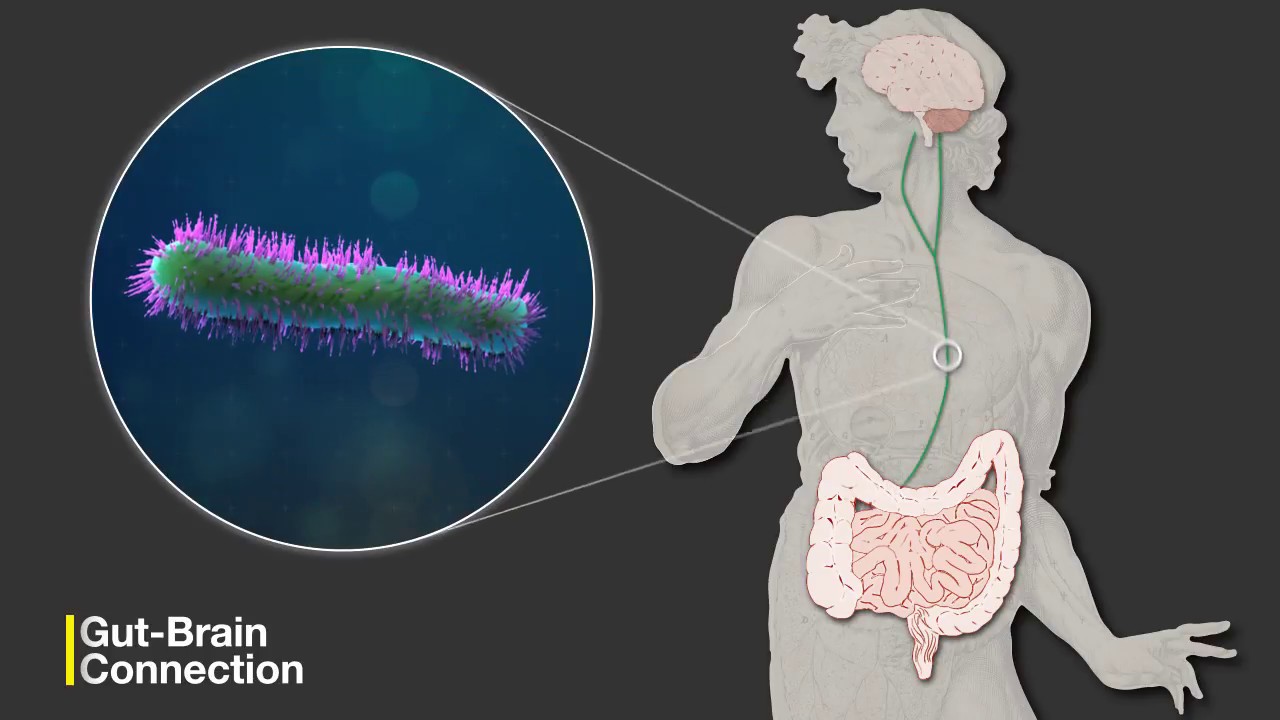
The Gut-Brain Connection

Sources

Gut feelings: the future of psychiatry may be inside your stomach

Mind-body connection

11 Ways to Expand Your Consciousness

“It’s not the world that needs to change – it’s our consciousness we must raise” ~ Rasheed Ogunlaru

Raising your consciousness gives you power to create a happier and fulfilling life. It’s about opening yourself to newer possibilities, reconnecting with your inner self, embracing the divine within you and most importantly, free yourself from the pain and suffering that has been holding you down.

It is a beautiful journey towards becoming more conscious in all aspects of your life. Heightened consciousness breaks the walls of perception, perceived reality, and false beliefs.ways to raise consciousness

Here are 11 ways to raise your consciousness.

1) Find yourself

Once Allen Ginsberg said, “Follow your inner moonlight; don’t hide the madness.”

To find yourself first learn about yourself. Finding the real you is an enlightening experience; you are not what the society has told you to be, or the titles given to you. Don’t try to be anybody else, and live in these false illusions. Falseness is a confused loop – a temporary shelter that lowers your consciousness.

You can’t hide there for a long period of time because there is no peace in living this way. Cut your ties with falsehood. Being honest with your self raises your consciousness. Don’t choose to be a canvas, rather be the painter.

starstuffponderingstarstuff2) Observe and reflect

Have the courage to observe and reflect. Some people choose ignorance that lowers their consciousness eventually. Internal reflection will certainly help you better understand your thoughts, emotions, and provide clarity in your current life situation.

It is an important step towards growth. Acknowledge your problems and seek solutions. Meditation is a good way to start the process, even for 20 minutes daily will make a difference in your state of consciousness.

3) Be compassionate

10003490_613215808770885_649163302_n“There is no exercise better for the heart than reaching down and lifting people up.” ~ John Holmes

Practicing compassion can be one of the single most powerful exercises for boosting your level of consciousness. Compassion is an ability to acknowledge the emotional state of our fellow human beings. Several studies prove that people who practice compassion experience constant change in their brain and respond positively to stress.

Being compassionate towards yourself and others also helps you to not only forgive the other person but also overcome your own negative thoughts or emotions.

4) Don’t hold onto your past experience or your expectations

Understand the power of now and live in the present. Get absorbed into the current moment. Let go of the wretched feelings and negative emotions. Watch your pattern of being trapped into the past, and then break that pattern. Start doing something that makes you happy. Looking at the world from the window of your past is cheating on yourself. Your present is seeking you. Allow your mind to be conscious of the present.

ego

5) Keep your ego in check

Ego is a small portion of the whole being. Consciousness is the higher self. Scientists have proven the fact that your consciousness never dies. Ego is like an infection to the consciousness, a hindrance that blocks the growth of consciousness. But it’s curable. Ego doesn’t let you take conscious decisions. Keep asking yourself – is it the real you or is it the ego that’s talking?

6) Destroy blockages

There are multiple blockages in your mind that act as an obstruction to attain a higher level of consciousness. Being judgmental towards the self and others, your inability to forgive, having trouble accepting the reality or past emotional blocks that has been suppressed within your subconscious. It exists like a barrier in your mind which you have to break down. Set yourself free from all emotional and energetic blockages. Break the walls. By doing so, you will cleanse the soul and your mind will start functioning at a higher frequency.

7) Spend time alone

spend-time-alone“The true life is not reducible to words spoken or written, not by anyone, ever. The true life takes place when we’re alone, thinking feeling, lost in memory, dreamingly self-aware, the submicroscopic moments.”- Don DeLillo, Point Omega

It is important to catch up with yourself. Most of us consider loneliness as a threat or an occasion to fret in the void. Spending time with yourself allows the inner self to speak to you. Follow that voice. It’s your inner voice talking. Go on a walk to listen to your own thoughts, give gratitude for everything that you have in your life, listen to music, or get involved in a hobby that inspires you.

8) Step out of your comfort zone

“Life begins at the end of your comfort zone.” ~ Neale Donald Walsch

Step out of your comfort zone and into the discomfort of uncertainty. You never know what it holds for you. Get imaginative. Unravel new layers of your existence. Don’t feed your fear of falling or making a mistake. There is a lesson behind each stumble and fall. If you don’t stretch your comfort zone, you’ll never learn that lesson.

9) Love

“Your task is not to seek for love, but merely to seek and find all the barriers within yourself that you have built against It.” ~ Rumi

thoreau-300x293Some say love is a drive. Some say love is a vibration. The truth of the matter is that love cannot be labeled. It is far more sacred than these labels. Allow yourself to receive love and give love whole-heartedly and unconditionally to yourself and others. And in that whole-heartedness, you experience your consciousness expanding. You feel the bliss all around you.

10) Embrace nature

Connect with nature, the rustling leaves, colourful flowers, majestic trees, ever-changing clouds and fluid water. Be grateful for the nature around you because in time spent in nature never gees wasted. Feel a deep sense of peace and oneness within, and in that feeling lies the answers you seek.

11) Meditation and Exercise

Meditation opens up a direct link between yourself and the higher realms of consciousness. Simple meditation has tremendous benefits for the mind, body and soul. It can help you connect with your self, restore balance in your thoughts and emotions, lower stress and raise your vibrations, brings joy and clarity.

Image Source

Expand consciousness
1 2 35
6 7 8

The Intellectual Necessity for Living a Spiritual Life

“‘Inability to accept the mystic experience is more than an intellectual handicap.” ~ Alan Watts
atomic-structure

The intellect, the rational reasoning part of ego, wants to know everything. At least, it is true of this writer. It is human nature to want to understand life, the nature of the universe and our place in it, our experiences, and our purpose. What does it all mean?

We could say that the quest began with simple logic; philosophy and science born of the Renaissance have given us a rational means by which we can make such queries. There is, however, a fundamental problem that will eternally impede our efforts. As much as we humans celebrate how precisely we can model the universe with the rational scientific methods we have devised, we are only able to do so with an infinitesimal fraction of ultimate reality.

It appears that something beyond intellect is required to access the majority of what we are calling ultimate reality, something beyond the material, corporeal world. Looking beyond the corporeal thus implies an exposure to the spiritual world. For this sake of the article, let us say then that the composite of reality includes both material (rationally accessible) and spiritual (not rationally accessible) domains. If so, how do we access the spiritual domain?

First, let’s examine what we think we know about reality. We learn in elementary school science something about atomic structure and that the atom is mostly empty space. A hydrogen atom is more than 99.999% empty space. Yet, there is something even more unsettling than all matter being mostly empty space.

The observable universe consists of mass and energy whereby only 4.9% of the matter is ordinary matter. The remaining non-directly observable constituency of the universe has been relegated by mathematical models to what is called dark energy and dark matter; the make-up is roughly 68.3% dark energy and 26.8% is dark matter. Thus, we know that we have only observed 4.9% of the universe which is for the most part empty space.cube

Another thing that mathematical models speculate is that reality is far more dimensional than the 3-dimensional world known to our senses, or 4-dimensional world including the intellectual perception of time. Discussion of higher dimensions is beyond the scope here, but we can examine the notion briefly enough to understand the implications.

Recall Plato’s allegory of the cave in his Republic. Assume cave dwellers have been imprisoned since childhood, chained so that they could not see one another but only a wall that sits before them.

(This is a thought experiment, so life’s necessary activities like eating, going to the bathroom, hygiene and such should be suspended.) Behind them is light source. Between the light source and the prisoners, people are walking carrying objects and performing various actions.

To the prisoners their entire reality is based on shadows that fall on the wall before them. Whatever their other senses – sounds and smells – tell them will be attributed to these shadows that make up the world as they know it. Plato’s cave goes on to describe the experience of a freed prisoner and his interaction with those still imprisoned and how unbelievable the enlightened tales of the real world sound to the uninitiated.

I’ll leave it to the reader to explore this classic allegory. My intent is to introduce the concept of a lower level projection (a two-dimensional shadow) from a higher level domain (a three-dimensional world).

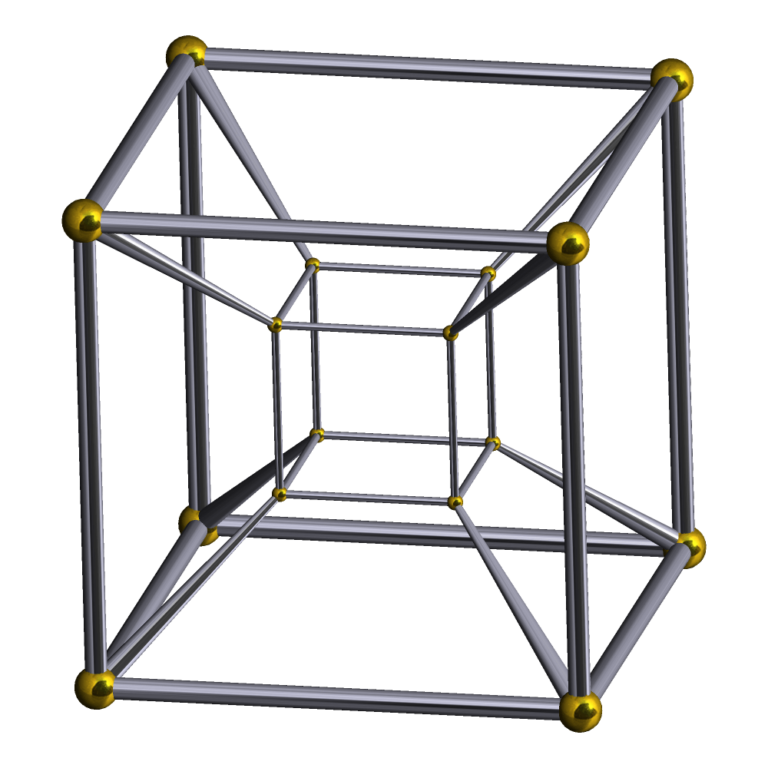
A more developed sense of higher dimensions and projections was treated in several 19th century works, most notably those by Charles Howard Hinton who coined the term tesseract, as the fourth dimensional analog of the cube in his work “A New Era of Thought.” Hinton’s writings influenced P.D. Ouspensky and Claude Bragdon, who in his book “A Primer of Higher Space” illustrated Hinton’s ideas.

Like Plato’s cave, a projection of a cube (its cross-section) would appear on the wall as a 2-dimensional square or, depending on its alignment with the light source, any one of a number of polygons. A perfectly normal cross-section of a cube is a square. A cross-section of a square is a 1-dimensional line.

Its cross-section is a point source. Now we must ask what kind of object exists in 4-dimensional space such that its projection in 3 dimensions is a cube? The answer is the tesseract and it is not something one can grasp easily with the intellect.
Schlegel_wireframe_8-cell
And what of higher dimensions? Contemporary cosmological models, one such being string theory, describe a universe of perhaps 10 or 11 spatial dimensions. To the rational mind the universe begins to look mighty irrational. Using only the senses, including instrumentation to improve sensitivity and accuracy, we can only intellectualize a fraction of the spatial dimensions of the universe.

Within the 3-dimensional fraction of reality, we only sense 4.9% of the matter which is greater than 99.999% empty space. So, exactly what are we attempting to model with theoretical and repeatable experimental methods based on laws that govern only a fraction of the whole?

When one recalls Shakepeare’s quote in Hamlet, “There are more things in heaven and earth, Horatio, than are dreamt of in your philosophy,” this should crystallize in one’s mind: to better understand our place in the universe and to become fully self-actualized, we must nurture our spiritual connections to that which lies beyond the veil of logic and science.

There are many tools and techniques to explore. Exercise in this manner, practice as it may be called is really religion with a lower case “r.” Set aside monotheism, polytheism, atheism or every “-ism” for that matter. Set aside all dogma and religion with an upper case “R.” The intellect mandates that we lead a spiritual life to reach our highest potential. What separates intellectus from spiritus is the ego; and there lies the rub!

Image Source

Dark Matter

Tesseract

Dimensions

No Tree Knows Mystery – Drawing Parallels Between the Life of a Human and a Tree

1

Nature is a marvelous teacher. If you look closely at any part of nature, you will realise there is something to learn from everything, even a tree. The life of a tree has many parallels to the life of a human.

While most of these similarities are physical, there are existential lessons to be learned from the physical as it is how we process and experience life. Let’s take a look at what these words convey.

From the very beginning of a tree’s life, we can see parallels to our own lives. While the processes are different, a seed is planted in the earth much like sperm and ovum are planted in the uterus.

psy-treeThe seed begins to grow in two directions remarkably similar to the zygote which divides and grows through mitosis. The earth is the womb to the seed as the mother is the womb to zygote.

Thus, the beginning of the lesson provided by the tree is that many things in life grow in two directions. We as humans are often taught that light is good and darkness is evil. The tree shows us that this is not the case as by growing down into the earth it nourishes, anchors and stabilizes itself.

Simultaneously, the tree grows up into the atmosphere. Here, we see how the tree seeks sunlight to harness, convert and store its energy. The message is of maintaining a balance of up and down, dark and light, and that our primary sources of physical existence are the sun and earth.

During birth and youth, the tree is vulnerable much like the humans. It requires proper environment to grow and flourish like nutrient rich soil, water and sunlight. The tree is shaped by its environment as the wind, soil, rain, rocks, animals and human constructs promote or interfere with its growth.
Young humans too are profoundly influenced by their environment, both physically and emotionally. Humans require atmosphere, water, food, clothing and shelter as well as care givers to love and teach them.

Life-itself-is-your-teacher-bruce-lee

Again a parallel, the earth and sun are to the tree what the mother and father are to the child. As the tree transitions from sprout to sapling, it must be strong yet flexible as the elements in nature are at times harsh.

The perils of the adolescent tree are many and include fire, drought, flood, extreme temperature, wind, moss, other plants, insects, animals and humans.

These same elements are concerns to young humans as well. Apart from physical, humans have emotional and psychological needs that are ideally provided in a beneficial manner yet many times they are detrimental; much akin to treachery within nature. This parallel is that the beneficial supports and nourishes while the difficult strengthens and prepares us for future challenges.

Throughout its existence the tree grows, blooms, reproduces, sheds, sometimes goes dormant and eventually dies just as all physical entities must. Humans also have seasons in life, and while we do not shed leaves we do have friends and family that perish (parts of our family tree).

The physical losses of the tree are much like the physical losses of humans, yet we have an emotional/psychological component. A lesson from the tree shows that while it may lose all of its leaves and even some branches in the fall – there will soon be new leaves to grow and new branches that will help nourish its growth.

Each time we lose a loved one we are given an opportunity to give that love to someone else, someone that needs it and someone that may very well respond in kind.
advice from a tree
In life trees behave in response to the seasons. They have means to procreate. They house many other organisms from the microscopic, to insects, reptiles, to birds, primates and in death they even house humans.

They usually live for many years and provide stability and nourishment to topsoil. They provide shade, weather protection, oxygen, sometimes food in life and then in death they provide timber for building, heating and cooking.

As we live our lives, we humans have comparable experiences and provide many of the same services to each other as well as to other species whether intentionally or inadvertently.

Another phenomenon that the tree demonstrates well is how life continues uninterrupted even after what appears to be an end. Consider the tree that provides firewood to cook a meal that a human eats.

In this instance, the life of the tree (its stored energy) is released to feed the fire which in turn cooks the food to feed a human who in turn has a child that plants a tree. Thus the tree shows us how there is no beginning, and no end to life. Life is a cycle that does not judge or condemn or expect anything. It just is.

There are many lessons here as the tree does not begrudge or charge the insects and animals that take residence, sustenance or proximity to it. The tree gives much while taking only what it requires from the earth and the sun.

It grows up into the light, and it grows down into darkness. All it has to give, it offers unconditionally without expectations and regrets.

In the bleak of winter, it stands patiently awaiting spring without self-pity, complaint or worry. The tree in its simplicity understands that it is a beautiful part of something much grander than itself and if you care to observe its example you can learn from what it leaves.

Image source
Tree and human

7 Reasons Why You Fail to be Extraordinary


Life isn’t easy. We all know that. It has a way of kicking us in the teeth when we’re smiling. But sometimes we’re too easy on ourselves. Sometimes we need to hear the hard and ugly truth of why our lives are stagnant and unproductive.

Sometimes we need to be brutally honest with ourselves as to why we aren’t doing anything amazing with our lives. I’m not talking about things that we can’t control, like what socioeconomic class we were born into, or what 1st 2nd or 3rd world country we were born in.

thomas-jefferson-quote

I’m talking about the things that we can control, like our overall attitude toward life, and our sense of motivation.

Here, then, are seven reasons why you may be failing to be extraordinary.

1) Because you’re afraid of failing

“We could never learn to be brave and patient, if there were only joy in the world.” ~ Helen Keller

Ironic, isn’t it? That number one on this list of failing to be extraordinary is that you’re afraid of failure. It’s true though. Why is this? Because when you’re afraid of failing you never truly begin.

When you’re worried about how well you’re going to do something that you’ve never done before, you tend to not try at all because it is so daunting a task to begin with. But there is a way to flip the tables on this psychological dynamic: make the goal to fail as fast as possible and then learn from your mistakes.

Keep doing it over and over again. With enough practice you will be able to fall flat on your face and jump back to your feet without even blinking. And the next time you try, you will be that much stronger and wiser.

You may fail again, but so what. Keep repeating the cycle, over and over. Bite off more than you can chew, and then learn why and how it was more than you could chew. Then go back and bite off some more. With enough courage and determination, you might just have the capacity to become extraordinary.
question-authority

2) Because you’re too busy being obedient

“But I don’t want comfort. I want God, I want poetry, I want real danger, I want freedom, I want goodness. I want sin.” ~ Aldous Huxley

Because you don’t question authority nearly enough, which should be always. Because you are too busy sitting on your ass taking orders like a good little armchair quarterback to do anything worthwhile with your life.

Get out of that La-Z-Boy chair and question what you’re being told: by the TV, by news, by your parents, by teachers, by your chain of command, even by me and this article.

And especially question yourself. Question your internal authority figure to its absolute roots, and then question those roots until all that’s left is a pile of unanswerable questions. Then you’ll finally be getting somewhere.

What if it’s all a lie? How many extraordinary people do you think became extraordinary by following the crowd, or by obeying obsolete orders, or by fawning to parochial commands? That’s right, zero! Rise up! Become a freedom unto yourself. Then, you might just have the capacity to do something extraordinary with your life.

3) Because you lack imagination

“Art is not a mirror held up to reality, but a hammer with which to shape it.” ~ Bertolt Brecht

This is a big one. Most of us are so entranced by the “way things are” and so dumbed-down by corporate media and intrusive advertising that our imaginations have been dulled-down to almost nil. Nobody does anything amazing with their lives without being imaginative and creative.

Nobody! Doing something extraordinary requires extraordinary thinking. It requires, not only thinking outside the box, but demolishing the box and then creating something new out of the destruction.

It requires shattering mental paradigms and then sticking the shattered pieces back together in a way that makes people’s jaws drop to the floor. It requires pushing envelopes until your fingers are bleeding from so many paper cuts that you’re able to use the blood to write “Art should disturb the comfortable and comfort the disturbed” (Banksy) on the plate glass window.

Wake up! Use the key of your imagination to unlock the Creative Gatekeeper’s door, and then you might discover the capacity to do something amazing with your life.

think
4) Because you worry too much about what others think

“I never made one of my discoveries through the process of rational thinking.” ~ Albert Einstein

Do you think Einstein gave two blue shits what the scientific status quo thought about him? What about Jesus? Do you think he was worried about what the Jewish orthodoxy thought about his unorthodox, rebel-rousing philosophy?

Or Martin Luther King Jr., do you think he cared what people thought about his going to jail 40 different times for social justice? What about Gandhi? What about Thoreau? What about Edward Snowden and Malala Yousafzai?

They didn’t worry too much about what people thought about them, they just worried enough to get the job done. And so should you. Pull your head out of the status quo noose. Part the raging sea of their negativity like Moses parting the Red Sea. If you can do that, then you might gain the capacity to accomplish something extraordinary.

5) Because you’re letting cognitive dissonance get the best of you

“Every time you are tempted to react in the same old way, ask if you want to be a prisoner of the past or a pioneer of the future.” ~ Deepak Chopra

Your worldview is a terribly precious thing. You’re like Shmegol from Lord of the Rings, clinging to it like a deranged immature child. Cognitive dissonance is a peculiar psychological predicament that is also a double-edged sword.

On the one side it keeps you safe and secure in your perception of reality. On the other hand it prevents you from accepting a new worldview that may be healthier than the one you’ve been clinging to.

But, in order to become someone who has the ability to achieve greatness you have to be able to maintain a precarious balancing act between the two sides, pushing yourself to empathize with other people’s worldview, while also trying to stretch your own worldview like one would stretch a comfort zone, all without going crazy along the way.

It’s tricky, and there are cognitive biases galore. But if you can master your cognitive dissonance, or at least become aware of how it affects your perception, you might yet gain the capacity to do something amazing.

read

6) Because you don’t read enough

“You want weapons? Go to a library. Books are the best weapons in the world.” ~ Doctor Who

This is another big one. The only way you can penetrate the minds of those extraordinary souls who came before you is to read. Reading a book by an amazing author is like standing on the shoulders of giants and seeing even further than they did.

If you have only ever read one book, and you refuse to read anything else that might stretch your mind, then you doom yourself to ignorance and one-right-way thinking that will prevent you from ever being able to do something amazing with your life.

Don’t let this happen to you. Go to the bookstore, buy a cup of coffee, grab two or three books off the shelf, curl up into a comfy chair, and lose yourself in the mind of another person. See the world from their unique perspective.

It will help you become more emphatic and compassionate, while also helping you with cognitive dissonance. Don’t let yourself become a victim of the now common cliche: you can lead a horse too water, but you can’t make him drink.

greed

7) Because you worry too much about money

“In a country well governed, poverty is something to be ashamed of. In a country badly governed, wealth is something to be ashamed of.” ~ Confucius

This is probably the biggest blocker to your greatness that there is. You want to know why your life is stagnant and not going anywhere? Because you have devoted yourself to a daily grind that does nothing more than pay for crap that you don’t need, while keeping you helplessly dependent upon an unsustainable system.

You’re a wage-slave, nothing more. You’re a corporate cog, grinding your life away so that some boss, CEO, or master can sit on his fat-ass and eat caviar out of a million-dollar dish while you’re using food stamps to buy almost-expired bread made by Monsanto.

Worrying about money is your jail cell. Worrying about paying next month’s rent is the psycho-social snare dragging you from month to month, year to year, decade to decade, until you’re lying on your death bed wondering what happened to your life, asking yourself, “Why didn’t I travel more? Why didn’t I read more? Why didn’t I paint more? Why didn’t I write more poetry? Why didn’t I take more risks? Why did I listen to everybody else about how I should live my life? Why wasn’t I able to do something amazing with my life?” And the only answer you can come up with is: because I was too worried about making money.

Image Source:

Jefferson quote
Question authority
Read instead
Need more money