Home Blog Page 347

Ahimsa

2

What is Ahimsa?

Jain Ahimsa LogoAhimsa (अहिंसा ahimsā) is a Sanskrit term meaning non-violence, the literal meaning is the avoidance of violence. It is an important part of Hinduism, Jainism, and Buddhism.

The hand with a wheel on the palm symbolizes the Jain Vow of Ahimsa, meaning non-violence. The word in the middle is “ahimsa.” The wheel represents the dharma chakra, to halt the cycle of reincarnation through relentless pursuit of truth.
Hindu Scriptures on Ahimsa:

Ahimsaa paramo dharmaah: (Mahabharat – Aadi Parva – 11.13)

Meaning – Ahimsa (non-injury) is the ultimate dharma (duty).

amaanitvam-adambhitvam-ahimsaa kshaanti-aarjavam
aacharya-upaasanaam-shoucham sthairyam aatma-vinigraham (Gita 13.7)

Non-injury to others (physical or mental) is prescribed as virtue in personal conduct.

Sookshmayoni ni bhootaani tarkagamyaani kaanichit
PakshmaNopi nipaaten yeshaan syaat skandhparyayah:
– Shanti Parva 15.26

Meaning – So many very tiny invisible lifeforms, whose existence can be ascertained by logic only, fill this world, that by mere batting of an eye lid we severe their limbs apart. Although actions such as eating, taking medicines result in some violence, this is unavoidable ahimsa needed for preserving one’s body. As the Bhagavat tells us:

Jivo jivasya jeevanam Bhagavat – 1.13.46

Knowingly or unknowingly a larger life form consumes a smaller life form, thence complete ahimsa is not possible. Also in this respect one must define right or justifiable himsa, and unjustifiable himsa.

Promoters of Ahimsa:

In its Eastern form, the principle of ahimsa was significantly promoted in the West by Mahatma Gandhi. Arguably Gandhi’s non-violence movement may have influenced Western civil rights movements, led by people such as Martin Luther King Jr.
A Young Mahatma Gandhi

Some of Gandhi’s quotes,

“When I despair, I remember that all through history the way of truth and love has always won. There have been tyrants and murderers and for a time they seem invincible, but in the end, they always fall — think of it, always.”

“An eye for an eye makes the whole world blind.”

“There are many causes that I am prepared to die for but no causes that I am prepared to kill for.”

Another well known promoter of Ahimsa is Ram Dass, a contemporary spiritual teacher who wrote the 1971 bestseller Be Here Now (Be Here Now is considered by many a manual to make the transition from a psychedelic lifestyle to a yogic lifestyle). He is well-known for his association with Timothy Leary at Harvard University in the early 1960s, both having been dismissed from their professorships for experiments on the effects of psychedelic drugs on human subjects.

After his visit to India where he met Hindu guru Neem Karoli Baba, Ram Dass return to the United States in 1969. He founded several organizations dedicated to expanding spiritual awareness and promoting spiritual growth, including the Hanuman Foundation.

Since then he has embraced a wide variety of spiritual traditions and practices, including guru kripa, bhakti yoga focused on the Hindu spiritual figure Hanuman, meditation in various schools of Buddhism including Theravada, Mahayana, Tibetan, and Zen; karma yoga; and Sufi and Jewish studies.

When asked if he could sum up his life’s message Ram Dass replied, “I help people as a way to work on myself, and I work on myself to help people… To me, that’s what the emerging game is all about.”

Resources:
The Hindu View’s on Ahimsa

Stereograms: Trick Your Eyes!

32

Stereograms are 3D images that have another dimension hidden within them. To unlock that dimension you need to trick your brain to either to make your eyes focus either beyond the image or before the image.

“Have you ever seen a stereogram?
The ‘Truth’ the Stereogram shows us is there in front of us. Training and work doesn’t make us see it. It’s a point of view, a different way of looking at it. When you see it you try to explain it to someone else and you realize you can’t. It simple, super simple, yet almost impossible to explain. There are ‘techniques’ to see them but some people may spend years trying without results. Others can do it in seconds. It doesn’t change the fact that the image is there all the time in front of us.
And it’s Beautiful.” ~ T.R. Cordón

How to See Stereograms?

Normal Viewing of Stereogram
When we usually look at anything, a picture, a cd or anything we focus on the object. This is how we have trained our eyes from the time we are born. Using this method we do not see the third dimension in Stereograms.

There are two methods where by we can see the hidden 3D images in sterograms.

One is the Parallel Method and the other is the Cross Eyed Method.

The Parallel Method:

Parallel Viewing of Stereograms
Is also known as the divergence or Magic Eye method, the point of focus is moved beyound the image. Basically it is to look through the image and focus at a point beyound. The line of site is sort of parallel when approaching the image hence its named this. When you use this method the muscles inside your eye that control the focusing lens relax and lengthen.

The Cross-Eyed Method:

Cross Eyed Viewing of Stereograms
The Cross Viewing method, can be enabled by focusing your eyes at a point before the image in the middle of it. This way the line of sight from each of your eyes cross in front of the image. When you use this method the muscles inside your eye that control the focusing lens contract strongly and shorten.

A Couple of my Favorite Stereograms:

I have tried staring at a Stereogram for hours and never managed to see it. Until my friend Warrel actually took the trouble of teaching me to do it. The first Stereogram is the one below.

Spinning Tops Stereogram

The first time I saw it, I was zapped stared at it for 5 minutes and kept on doing it. Looking at the world in 3D is so much fun.

Here are some more that I liked

Twisting Star Stereogram
Clover Leaf Stereogram
Pine Tree 3D Image

Stereograms In India:

Stereograms with Aum symbols are available in India. These stereograms help in meditation, this kind of Meditation is knows as Pranava Yantra.

It seems if you look into the stereograms for 3 – 5 minutes everyday they can have many beneficial effects such as:

Relaxes your mind

Improves concentration

Balances emotions and reduce mental tension

Freedom from worries and anxiety

Cure headache, insomnia, high blood pressure, depression and other stress related problems.

About Stereograms:

Butterfly Stereogram
Stereogram was discovered by Charles Wheatstone in 1838. He found an explanation of binocular vision which led him to construct a stereoscope based on a combination of prisms and mirrors to allow a person to see 3D images from two 2D pictures.

Stereograms were re-popularized by the creation of autostereogram on computers, where an 3D image is hidden in a single 2D image, until the viewer focuses the eyes correctly. The Magic Eye series is a popular example of this. Magic Eye books refer to autostereograms as stereograms, leading most people to believe that the word stereogram is synonymous to autostereogram.

Salvador Dalí created some impressive stereograms in his exploration in a variety of optical illusions.

Resources

Wonderful collection of Optical Illusions! (Must See)

All About Stereograms

Source of Methods to View Stereograms

The Colour Factor

3

colour-factor
Most people think of colour as how things look and something that is attractive, and often dismiss it as being cosmetic. But it has a much deeper and significant connotation.

It’s the first thing we register while assessing a thing. So the colours you wear and see directly affects your mood and influences your behaviour.

For instance, decorating your room with daffodils, roses etc. would make you feel livelier. Scenic pictures with mountains and waterfall would instantly draw you in.

So the colours of our surroundings or place where we live in instantly affects our mood. Different colours symbolise different emotions. Like Red would evoke a feeling of confidence, danger, power etc. Green, a colour related to life, evokes a sense of peacefulness and tranquility.

When you go to a hill station or a mountainous area you tend to feel relaxed and rejuvenated, that is because of the visual contact with colour green, the colour of nature. Blue is the colour of honesty, integrity and trustworthy, while White stands for purity and cleanliness.

However, a person’s response to colour varies; it is largely subjective. If my favourite colour is blue, which is soothing and calm another person might perceive that colour as being cold and unfriendly. But it is the combination of colours that generates response.

Angela Wright, a psychologist, in her exploration of colour psychology speaks about how colour is not just a visual phenomenon but it also has a physical effect on us.
jimi hendrix
Colour and Music

Colour and music works on similar lines. Perhaps that’s why you have the sound and light show, the combination is very exciting, vibrant and uplifting.

Jimi Hendrix in 1970 reflected – “I’m thinking of the days when people will be able to have this little room, a total audio-visual environment type of thing. So that you can go in there and lay back and the whole thing just blossoms with colour and sound. Like a reflection room. You can just go in and jingle out your nerves. It would be incredible if you could produce music so perfect that it would filter through you like rays, and ultimately cure.”

Read more on Colour and Music

Colour Psychology
The effect of colours on us is caused by their energy entering our bodies. The eleven basic colours have fundamental psychological properties that are universal, regardless of which particular shade, tone or tint you use. Each of them has potentially positive or negative psychological effects.

The psychological properties of the eleven basic colours are as follows:

Flowers of different colours

RED
Positive: Physical courage, strength, warmth, energy, basic survival, ‘fight or flight’, stimulation, masculinity, excitement.
Negative: Defiance, aggression, visual impact, strain.

BLUE
Positive: Intelligence, communication, trust, efficiency, serenity, duty, logic, coolness, reflection, calm.
Negative: Coldness, aloofness, lack of emotion, unfriendliness.

YELLOW
Positive: Optimism, confidence, self-esteem, extraversion, emotional strength, friendliness, creativity.
Negative: Irrationality, fear, emotional fragility, depression, anxiety, suicide.

GREEN
Positive: Harmony, balance, refreshment, universal love, rest, restoration, reassurance, environmental awareness, equilibrium, peace.
Negative: Boredom, stagnation, blandness, enervation.

VIOLET
Positive: Spiritual awareness, containment, vision, luxury, authenticity, truth, quality.
Negative: Introversion, decadence, suppression, inferiority.
Colors of your house can affect your mood
ORANGE
Positive: Physical comfort, food, warmth, security, sensuality, passion, abundance, fun.
Negative: Deprivation, frustration, frivolity, immaturity.

PINK
Positive: Physical tranquillity, nurture, warmth, femininity, love, sexuality, survival of the species.
Negative: Inhibition, emotional claustrophobia, emasculation, physical weakness.

GREY
Positive: Psychological neutrality.
Negative: Lack of confidence, dampness, depression, hibernation, lack of energy.

BLACK
Positive: Sophistication, glamour, security, emotional safety, efficiency, substance.
Negative: Oppression, coldness, menace, heaviness.

WHITE
Positive: Hygiene, sterility, clarity, purity, cleanness, simplicity, sophistication, efficiency.
Negative: Sterility, coldness, barriers, unfriendliness, elitism.

BROWN
Positive: Seriousness, warmth, Nature, earthiness, reliability, support.
Negative: Lack of humour, heaviness, lack of sophistication.

The above properties definitely holds true for everybody, its just that we don’t realise it. Personally, the colours I wear reflect my state of mind and my mood. If I am in a pink or a bright colour, I would be in a very jovial and chirpy mood. Whereas a black outfit makes me feel gloomy and sad. Based on that you also emanate those kind of energy and vibes to people around you. So be colourful!!!

Resource

Different colour evokes varied feelings and emotions.

Louis Wain ~ The Mind of a Schizophrenic

60

Have you ever wondered what goes on in a Schizophrenic mind? Curious to know what a Schizophrenic sees or feels?

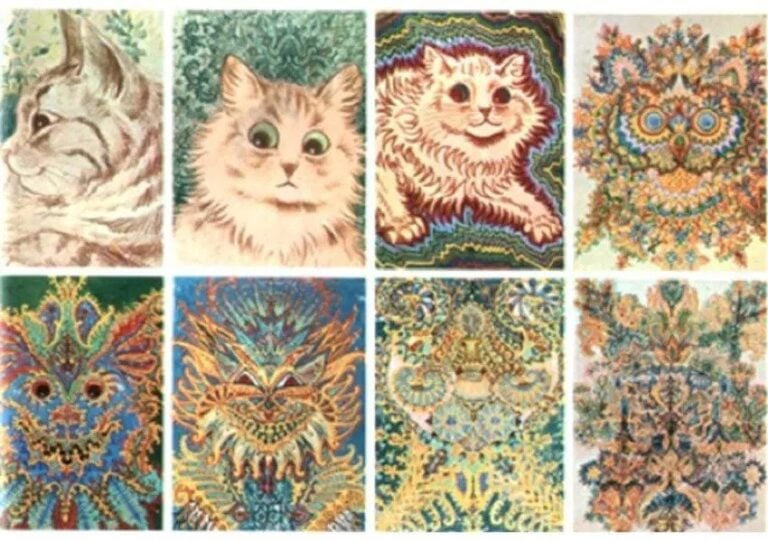
Louis Wain, an English artist known for his drawings that usually featured cats, a look at his art gives us clue’s to what goes on in a Schizophrenic’s mind…Louis Wain
Louis Wain’s Cats
louis wain art

Louis Wain illustration of cats singing carols

Louis Wain’s work is dominated by fanciful imagery of cats dressed in human clothes or engaged in human activity, considering that much of his work was political cartooning and illustrations for children’s books.

It is a common notion that his early work seems to be a representation of his pre-schizophrenic period. This claim has been refuted by Rodney Dale, author of Louis Wain: The Man Who Drew Cats, who has criticised the belief that the paintings can be used as an example of Wain’s deteriorating mental health.

He said, “Wain experimented with patterns and cats, and even quite late in life was still producing conventional cat pictures, perhaps 10 years after his [supposedly] ‘later’ productions which are patterns rather than cats.”

louis wain

We arranged his art in a form of increasing psychedelia, .however, it is not known if these works were created in this order, as Wain did not date them.

d4901ccdf3a9204d4a92d6188e3b824a
schizophrenic-cat
feat LW e1491719313191

Wain continued to paint, draw and sketch cats, but he also chose to focus on the cats apart from just fanciful situations.

It seems like the characteristic changes in the art began to occur, changes that are seemingly common to schizophrenic artists.

Jagged lines of bright color began emanating from his feline subjects. The outlines of the cats became sever and spiky, and their outlines persisted well throughout the sketches, as if they were throwing off energy.

The abstraction continued, the cats now being seen as made up by small repeating patterns, almost fractal in nature.

Until finally they ceased to resemble cats at all, and became the ultimate abstraction, an indistinct form made up by near symmetrical repeating patterns.

b3621cf2c32947d0c303d28739e9ad67
About Schizophrenia

The term ‘Schizophrenia’ was first coined by Swiss psychiatrist Emil Bleulur from the Greek skhizein “to split” + phren “mind,” the idea being that schizophrenics suffer a break from reality, causing them to perceive the world in a bizarre or fantastical way.

Negative Schizophrenia Symptoms

Affective flattening – A severe reduction or complete lack of emotional responses to the environment.

Alogia – A severe reduction or complete lack of speech.

Avolition – An inability to persist at common, goal-oriented tasks.

Positive Schizophrenia Symptoms

Delusions – Beliefs with little or no basis in reality (e.g. beliefs that you are being persecuted or beliefs that you are the Messiah)

Hallucinations – Unreal perceptual or sensory experiences (e.g. hearing, seeing, or feeling things that are not there.)

Disorganized thought and speech – Grossly disorganized pattern of speech (e.g. complete incoherence, linking together words because of sound instead of meaning)

Disorganized or catatonic behavior – Behavior that is highly unpredictable, bizarre, and/or shows a complete lack of responsiveness to the outside world (e.g. becoming completely motionless for long periods, sudden, untriggered outbursts)

Of these positive symptoms delusions, in particular, can be broken down into smaller subsets:

Persecutory delusions – False beliefs that one’s self or one’s loved ones are being persecuted, watched, or conspired against by others.

Delusions of being controlled – Belief that one’s thoughts, feelings, or behaviors are being imposed or controlled by some external force

Thought broadcasting – Belief that one’s thoughts are being broadcast from one’s mind for others to hear

Thought insertion – Belief that another person or object is inserting thoughts into one’s head

Thought withdrawal – Belief that thoughts are being removed from one’s head by another person or object

Delusions of guilt or sin – False belief that one has committed a terrible act or is responsible for some terrible event

Somatic delusions – False belief that one’s appearance or part of one’s body is diseased or altered

Grandiose delusions – False belief that one has great power, knowledge, or talent or that one is a famous and powerful person

LSD and Schizophrenia

LSD is a drug that puts the user in the shoes of a schizophrenic. It actually helped a lot of psychiatrists understand what a schizophrenic goes through in his daily life when the lysergic experiments were on.

Chronic effects of the drug can be positive and negative. Positive effects include spiritual contact and self-exploration; the most severe negative effect is known as LSD psychosis. LSD has shown to have therapeutic usefulness, although research has been severely limited for the last several decades.

LSD psychosis has been linked to forms of schizophrenia, and thus, to some physiological disorders — it appears to be dependent on the user, and not on the drug.

Sources:

Louis Wain

Unlock the Power of Astral Projection – The Self has no Boundaries

5

Heard of that term before? After a conversation with a friend on tarot cards, interpretation of dreams and one’s subconscious mind, I was quite curious on finding out what it was all about and the research was a bit startling. If you interested in finding more about it, please continue reading.

What is Astral Projection?

You’ve ever woken up in the middle of the night with a jolt or an involuntary jerk, well, this is the astral body returning to the physical body. Astral Projection is basically an out of the body experience, OBE as its called. When a person sleeps in the night, your astral body (soul or consciousness) separates from your physical body.

astral projection
Astral Projection

As unusual it may sound, it actually happens to every one of us when we fall asleep. Its like when the physical mind is asleep, the subconscious takes over. That means, everybody does it, but they just don’t remember it. This is because the ego hasn’t put in the effort to recall it.

Same is the case with dreams, if they are viewed as unimportant by you, then you won’t remember them. Usually your dreams are in the beginning of the sleep cycle, and those dreams are nothing more than an accumulation of the events and thoughts during the day. If you wake up in the morning and remember your dream real well, it is usually an astral body experience.

Everyone is actually born with this ability to leave the body and go some place else, some place where they always wanted to go. So your physical body just rests without any harm.

It’s not like near-death experience

One might wonder whether astral projection is the same as having a near-death experience. That’s not true. In a death experience a person leaves the body for the final time, but when you astral project you decide where you want to go, and you are there, right away. You are controlling yourself with your subconscious thoughts. You must learn to allow the subconscious to take over, and not let the physical mind control you.

An astral experience

Many a times this can be achieved through drugs, especially LSD which helps you disconnect from your body and frees your mind. But some people do have bad trips, that’s because they don’t know how to handle an experience like that and they end up in the lower astral. One can have a full control of what you are doing and that is possible if one is free from distractions.

So have you ever had a paranormal experience?

Guided Astral Projection Meditation

Image Source:

Astral travel
Astral projection