Home Blog Page 49

Sophia, the Gnostic Goddess and our Search for the Divine Truth

4

Gnosticism, one of the most mystical movements in our history, has been buried and forgotten centuries after the spread of Christianity. This vision is now slowly re-awakening and winning people’s hearts. Maybe it is because it tells the story that humanity itself needs to listen again, and to remind us of our true nature…

“This is the basic insight of the Gnostics, the one known to the great mystical thinkers of all traditions: the divine spark is within each human being.” ~ Lesley Hazleton

According to Gnostics, which means mystical knowledge, there is an ultimate truth when it comes to the creation of the world and human suffering as a consequence of the deception we are trapped in. 

Sophia, the Gnostic Goddess and the Ultimate Truth

The ultimate truth is that Goddess Sophia (meaning wisdom in Greek), the creator of this Universe, in her intention to shape this world, wanted to create species that would have enormous freedom to play and explore, to enjoy, to feel pleasure, and to create by themselves anything they wanted.

Sophia did not separate herself from the thing she created. She was not an impersonal God that dictated what was right and wrong. Sophia was so fascinated and passionate about the creatures she dreamt about, that during the creation process she could not step away from her project as other Gods would do. Instead, she wanted to be involved in her creation and observe her creatures, and so she fell from the edge of the Universe i.e. the Pleroma, the totality of divine powers, full perfection. 

During this fall, she split herself in two parts; her most irrational passion became the world of matter – the Universe, and her higher part remained celestial. 

Nevertheless, she did not know that her fascination and involvement for her creatures would also have consequences. Due to her irrational passion and in her fall from the Pleroma, she cast the shadow of evil, incarnated and got entangled in the world of matter controlled by Demiurge. 

The Demiurge, according to Gnosticism, is the entity that possessed the world of matter and this entity was driven by greed and envy. The Gnostics believed that this entity wanted to take credit for the world Sophia created, claiming to be the true God, and wanted humans to worship him as the true creator of the Universe. 

He wanted to enslave the human race, and keep them distracted from finding the Truth that everything in this world had the divine spark of Sophia and that all humans had this divine print because Sophia is within all of us. Humans are beings of energy living in a body, and that we are much more than our physical boundaries, and knowing this is where our potential lied to transcend our limits created by our belief system.   

According to the Gnostics, as Demiurge had control over the world of matter, he tried to suppress humans as much as possible in their psychic power and visions. He wanted humans to believe that the only true reality that existed was this world of matter and what we could see with our physical eyes. 

How Gnosticism explained the development of our society

He could control the human mind, especially of those who sought power based on feelings of greed, envy and fear. He immersed himself in humanity’s belief system firstly as the monotheistic and patriarchal religions that took shape on Earth and later on modern societies were built based on fear of sin, and guilt.

This new God dictated that only through suffering the doors of salvation will open to humans. He suppressed the original sexuality and pleasure of humanity – as opposed to the way Sophia wanted her species to experience the world. 

The original religion of the Earth, since the Palaeolithic and Neolithic, was based on the Goddess and the symbiosis of sexuality and spirituality, sacred and mundane, humans and nature. This ancient religion was slowly repressed and persecuted as new forms of monotheistic religions started to have more power. The original gnostics, pagans, witches and shamans – all of those who worshipped the Earth and Sophia – were tortured, burned and killed during the beginning of the 1st century A.D. and later. 

The question that also modern gnostics think of is: what if hunger for power, greed and envy controlled the mind of humans carrying those atrocities? Which true God or Goddess would have wanted those terrible things to happen? For the gnostic was clear: only a fake God controlled human mind through a stage of anger, fear, and guilt. 

The true Gnostic understands that there is a difference between religious activity and spiritual truth.” ~ David Tresemer

The spiritual truth according to Gnostics

As the gnostics believed and also the pagans celebrated in their ceremonies, the presence of Sophia within all of us on Earth. The Earth itself is Gaia, the Goddess creator of Life that wanted us to feel joy and pleasure.

Societies that were connected to Nature and the Earth did not allow this new wave of belief system to dictate their way of living, because for them the doors of salvation and to the divine would open through joy, respect to nature, collaboration, pray and love. Consequently, many gnostics died defending what was true to them. 

The old religious system fell apart, and greed-driven corporations, consumerism and totalitarian governments took the place of the new God. This was interpreted by the Gnostics as the new way of the Demiurge that kept us blind to our true nature – our origin as creatures of Goddess Sophia.

If we look at the world we live in, we see how humans have been exploiting the Earth, digging her minerals and precious substances with machines without any respect or thought of sustainability. Technology has been a big step for us to allow faster communication and have higher life standards. We have freedom to create, as Sophia wanted us to do.

But are we really following her original desire to use our full potential and creativity, or have we gone in the wrong direction?

The lungs of our planet are being destroyed by continuous deforestation and exploitation of the land to get more profit. Oceans are being contaminated, the air is polluted, and wars continue to ravage our world. Is this the consequence of the disconnection to the Goddess, as it was in ancient traditions? Have humans lost their connection to the spirits of Nature and finally to the divine spark which is the print of Sophia, the origin of our Creation?

Perhaps we are unconsciously feeding our greed and allowing the Demiurge to take over our inner mystical origins and forgetting the sacredness of the Earth and ourselves. Is this the consequence of our belief that the world of matter is the ultimate reality, worshipping materialism and closing our spiritual eyes? 

“We are in times of great wings, swiping across our world. May these wings swipe away what we not longer need, and bring us back home to our true selves and all that is.” ~ Medicine Song

Nevertheless, as society is changing at a fast pace, we are now in a new wave of awareness. Our own consciousness is evolving, as more people are reconnecting to the energy of the Earth, to the compassion for all living beings, to the unconditional love to others and the healing power that is available when humans remember the divine spark that is within them and all creatures.

As the Gnostics predicted, humanity will wake up and realise the deception that has trapped them for a long time, impeding them to encounter the Goddess, the primordial Mother and force of the Universe, Sophia, which is the real longing of the soul and desire of human beings.  

“I am the Queen, source of thought, Knowledge itself. You do not know Me, yet you dwell in me.” ~ Ancient Gnostic texts

As the Gnostics and pagans believed, the most beautiful thing ever created is the Earth – Sophia herself materialised. We humans spend multiple lives trying to remember that we are part of Her as She is in each one of us.

We have forgotten this Truth, and it is time for us to wake up from the dream we are living, to acknowledge our true desires, to find happiness within, to connect again to the source of Infinite Love, through healing the Earth and giving back to her all the Love she gave us when she sacrificed her own divinity to create this living universe and finally, us.

Image Sources:

Art by Helena Nelson Reed
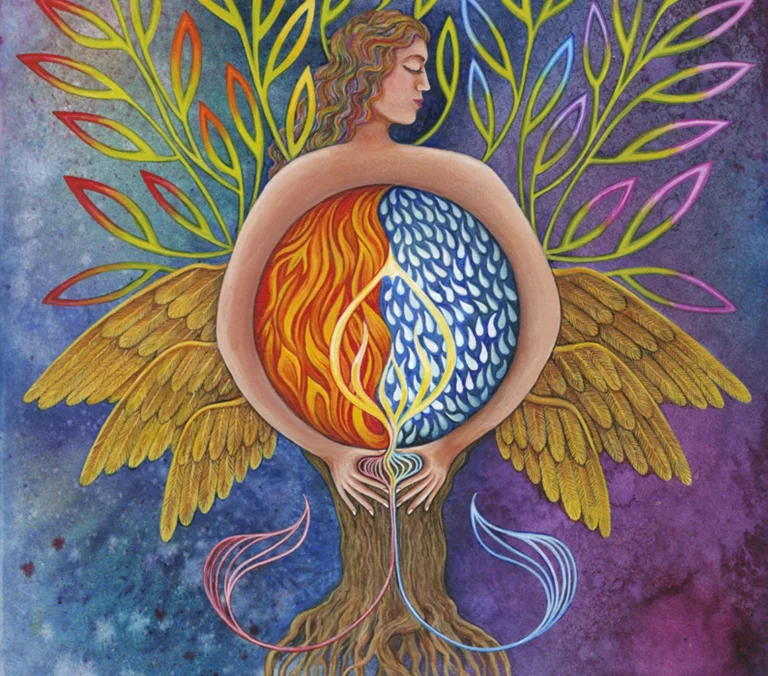
Balance, the Alchemy of Life

0

One of the main ways to create content is to look at sources for additional information. To be honest, I’m an avid reader, when I start I get so immersed in the book that the entire world stands still.

Not much to Bhavika’s liking as she has to break this cocoon to get me to help with the household chores, and then every moment I get I try to get back to an incomplete book. But to have healthy content coming in, I draw inspiration not just from experience, but by standing on the shoulders of giants as well.

On that note let me introduce you to a very famous book by Paulo Coehlo ~ The Alchemist, what’s interesting is just as much as I like the story in the book, the introduction to this version talks about how he struggled with getting the book to sell and how from selling just one book in a year or two, to becoming a bestseller.

Don't let this stop you, show us some love and subscribe to continue reading!

If you're already a member, please login.

Image Sources

Art by Kay Kemp

The Disastrous Effects of Childhood Trauma in Adults

4

“Many abused children cling to the hope that growing up will bring escape and freedom. But the personality formed in the environment of coercive control is not well adapted to adult life. The survivor is left with fundamental problems in basic trust, autonomy, and initiative. She approaches the task of early adulthood – establishing independence and intimacy – burdened by major impairments in self-care, in cognition and in memory, in identity, and in the capacity to form stable relationships. She is still a prisoner of her childhood; attempting to create a new life, she reencounters the trauma.”
~ Judith Lewis Herman

Trauma and Recovery: The Aftermath of Violence – From Domestic Abuse to Political Terror

Personal Experience with Trauma as a Child

If you did not have a traumatic childhood consider yourself lucky. There are a few memories that still play back in my mind – one of them was when I was punished for something I did not do. When I say punished it doesn’t mean sit in the corner, in India it is a common practice for children to be given a couple of whacks, slapped, hit with a slipper/flip-flop or even a cane.

During one of the annual festivals in suburban Bombay, Mount Mary’s festival, which was one of my favourite places to visit as a child. I used to get this little metal boat that I could put in a tub with a little candle to power it, and this used to make me really happy.

On the other hand, this festival had something of interest that most parents took home, a thin bamboo cane used for whipping. So it was always a funny thing, on one hand you have a boat and on the other a cane. I still remember walking down the streets of the festival and see the shops that sold the edibles, candles, so many knick-knacks and of course shops that sold the cane.

There’s a particular incident that I recollect very vividly to date, because I was not believed to be telling the truth when I was.

I have always been fond of animals, and as a kid we used to have these little budgerigars or love birds at home in a little cage. One day Sunny managed to escape his cage, when I noticed it I ran and told my mother, but she did not believe the bird could get out of the cage without assistance. He was sitting on the pelmet, and we couldn’t reach him, so she called my grandfather, and it was difficult catching him with him flying about out of their reach.

Although after he was put back in the cage, neither of them believed he could escape on their own, and I was at the receiving end of a situation I had not created. Every time I go back to my childhood I’m flooded with unhappy memories, I actually have to struggle to recollect the good ones, and this is actually how our brain works as humans.

If you have read my article on ways to grow beyond your childhood trauma I counter this behaviour by trying to recollect as many memories I have that brought me joy in my childhood, so it becomes easier to let go of bad ones.

I’m not here to talk about past traumatic experiences, I understand that the way I was brought up at that time was the norm for most children of my time. I remember the howls and screams of my neighbour’s children, seemed to me, they had it quite bad as well.

I’m well aware that it’s not just me who has suffered, some have suffered far worse and some less, but today there’s far more research on how going through this in childhood impacts adult life. I do hope more parents gain strength to break through generational patterns and provide children with an environment that helps build healthier adults.

“The greater a child’s terror, and the earlier it is experienced, the harder it becomes to develop a strong and healthy sense of self.” ~ Nathaniel Branden

Six Pillars of Self-Esteem


Importance of Childhood

The first 7 years of our lives lay the foundation for later learning and healthy development in all areas – emotional, psychological, physical or spiritual. If during that time a child has had negative or unpleasant experiences, such memories stay with the child for the rest of his/her life, leading to emotional challenges as an adult.

In the first seven years the child is like a sponge absorbing everything from his environment, our beliefs, behavioural patterns, responses and so on. So a happy childhood leads to an adult who is a balanced individual, whereas an unhappy childhood may cause imbalances in our thinking, behaviour and so on.

Rudolph Steiner suggests that before the soul of the child incarnates, the soul chooses its family and parents.

“Experience has taught us that we have only one enduring weapon in our struggle against mental illness: the emotional discovery and emotional acceptance of the truth in the individual and unique history of our childhood.” ~ Alice Miller

The Drama of the Gifted Child: The Search for the True Self

The effects of childhood trauma in adults

Unfortunately it’s not just bad memories that we carry forward to our adult life, childhood trauma leaves lasting effects on the brain and personality. Childhood trauma is not just rampant but linked to multiple forms of dysfunction.

Listed below are some effects of childhood trauma in adults that has been linked by research.

Common Psychiatric Disorders

Everyday life puts us into situations where we come across unknown people and situations, which is not very easy for people who suffered from childhood trauma. According to a study on social anxiety disorder and childhood trauma in the context of anxiety (behavioural inhibition), impulsivity (behavioural activation) and quality of life, a correlation was found between the severity of social anxiety disorder (SAD) symptoms and the amount of childhood trauma exposure. The research assessed five dimensions of childhood maltreatment: physical abuse, emotional abuse, sexual abuse, physical neglect and emotional neglect.

Those who have SAD display symptoms such as an intense fear of embarrassment, humiliation and negative evaluation, especially when they have to meet with people who they don’t know or if they are publicly scrutinized. This makes things awkward, and the person avoids these situations, this ends up affecting their social life and career.

Adverse reactions

Life tends to throw us a curveball sometimes and in worse case scenarios there are many times we hit rock bottom but some of us manage to pull ourselves out or crawl out of the situation. It isn’t easy to do and sadly yet again adults who have experienced childhood trauma have it far worse.

According to a study on “The Biological Effects of Childhood Trauma”, trauma activates the body’s biological stress response systems, this has behavioral and emotional effects that are similar to a person with post-traumatic stress symptom. A person’s biological stress response consists of different systems that interact with each other to protect oneself from threats and trigger the “fight or flight” system.

Inhibition of sexual behavior, core symptoms of major depression, higher cortisol levels which have effects such as weight gain, slowed healing, muscle weakness, severe fatigue, irritability, medical illness and brain structure damage. Adults with a history of childhood trauma also display hypertension, accelerated atherosclerosis, metabolic syndrome, impaired growth and immune system suppression and poorer medical health.

“The fetus is biochemically connected to the mother, and her external, internal, physical, and mental health affect the overall development of the fetus. Stress and depression during pregnancy have been proven to have long-term and even permanent effects on the offspring. Such effects include a vulnerability to chronic anxiety, elevated fear, propensity to addictions, and poor impulse control.” ~ Darius Cikanavicius

Human Development and Trauma: How Childhood Shapes Us into Who We Are as Adults

Drug Use

“The sheer weight of the many reports over the years certainly implicates child abuse as a possible factor in drug abuse for many people,” says Dr. Cora Lee Wetherington, NIDA’s Women’s Health Coordinator.

Although there isn’t enough data to understand the complete situation, studies are being conducted that help link childhood physical abuse and adult substance abuse.

In a particular study which included the social history and demographic data of 178 where 101 patients undergoing treatment for drug/alcohol addiction were from the United States and the other 77 from Australia, the study determined that a whooping 84% of the sample reported a history of child abuse/neglect.

Another study of 733 women found those who were physically abused as children more likely to abuse drugs as they grew older. Strangely that in this sample even after controlling family history of substance abuse the results were the same, making a healthy childhood imperative and even intervention and support.

Quality of Life

Abuse survivors are less happy, less satisfied and find living less worthwhile as compared to people who were not abused as children.

According to research, 9% more of people who have not been abused as children feel their health is very good.

abuse survivors quality of life


Apart from an inclination to drugs, studies have found that opioid dependent individuals who have a history of sexual abuse have poorer mental and physical health as compared to those with no sexual abuse in the past.

While other studies link adverse childhood experiences to a variety of issues that lead to early death, due to diseases like cancer, diabetes and more… either due to lifestyle or habits that are coping mechanisms to deal with the trauma.

image

Sadly people who have been abused have a higher probability of entering an abusive relationship in future.

Anti-social Behaviour

Two studies that I came across while doing this article linked childhood maltreatment and even harsh punishments dealt to children to anti-social behaviour in adults.

Pushing, grabbing, shoving, slapping, and hitting were considered as harsh physical punishment while child maltreatment included physical abuse, sexual abuse, emotional abuse, physical neglect, emotional neglect, and even exposure to intimate partner violence.

Both the studies confirmed that abused children display an increase in anti-social behaviour as adults. While one of the studies was a long-term study proved that even at the age of 50 years the survivors still show this anti-social behaviour.

Protecting Childhood

Frederick Douglass said that “It is easier to build strong children than to repair broken men.” Apart from the fact that he’s correct, if we pause and take a look at how human systems are functioning, from war, to poverty, to racism or nationalism, we’re ensuring we have an endless cycle of dysfunctional adults.

Those of us who have children have to really work hard to ensure we create healthy functional human beings, it’s even harder for those who have experienced trauma as they grew up to try breaking the cycle of abuse and consciously parent our children.

break the cycle 1 e1636696981469

My article on 4 ways to grow past your childhood trauma should help adults deal with their past, so they can rewrite their future and help protect childhood.

References:

People who were abused as children are more likely to be abused as an adult
Associations of Harsh Physical Punishment and Child Maltreatment in Childhood With Antisocial Behaviors in Adulthood
Child maltreatment and the risk of antisocial behaviour: A population-based cohort study spanning 50 years
A study of the relationship between child abuse and drug addiction in 178 patients: preliminary results

Image Source:

Unequally Yoked by Kirsten Beitler

I am Astonished, Disappointed, Pleased with Myself

0

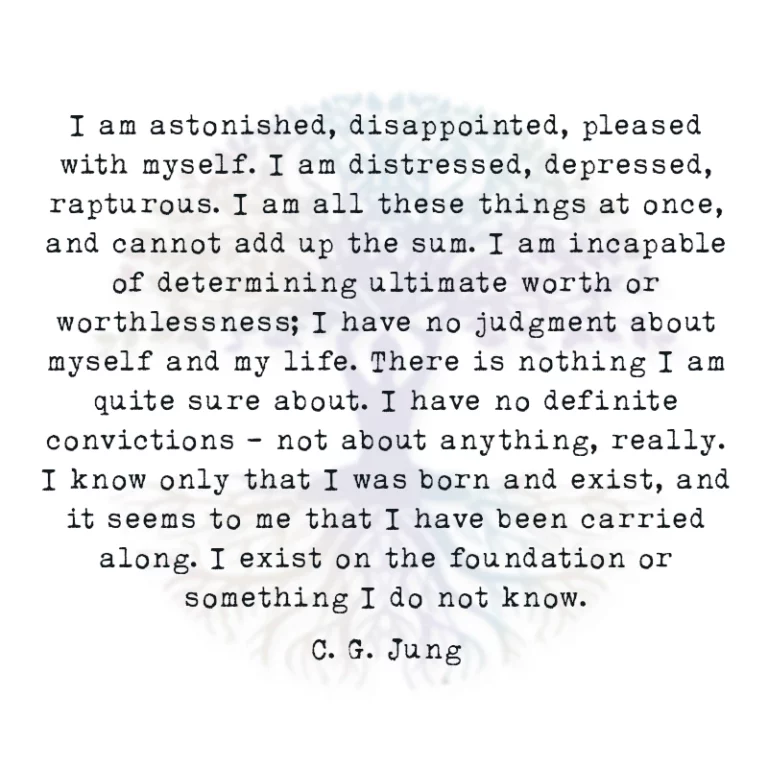
I am astonished, disappointed, pleased with myself. I am distressed, depressed, rapturous. I am all these things at once, and cannot add up the sum. I am incapable of determining ultimate worth or worthlessness; I have no judgment about myself and my life. There is nothing I am quite sure about. I have no definite convictions – not about anything, really. I know only that I was born and exist, and it seems to me that I have been carried along. I exist on the foundation or something I do not know.
~ Carl Jung Quotes

But Death is Extraordinarily like Life

0

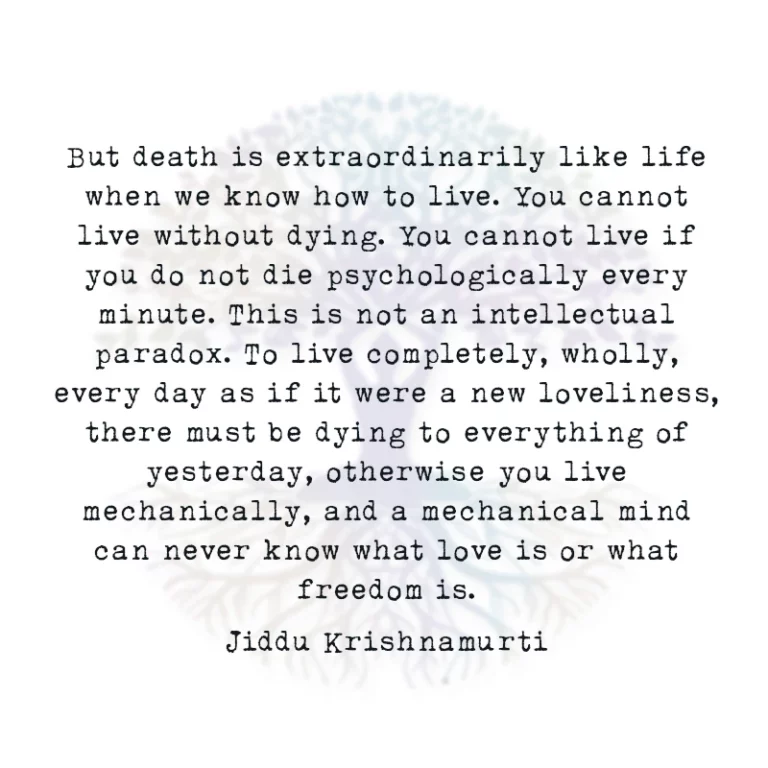
But death is extraordinarily like life when we know how to live. You cannot live without dying. You cannot live if you do not die psychologically every minute. This is not an intellectual paradox. To live completely, wholly, every day as if it were a new loveliness, there must be dying to everything of yesterday, otherwise you live mechanically, and a mechanical mind can never know what love is or what freedom is.
~ Jiddu Krishnamurti