
Choose people who:
~ Choose you
~ Ask how you are
~ See you
~ Let you be you
~ Feel good to your nervous system
~ You can breathe easily around
~ You don’t need to perform for
~ Are good for your mental health
~ Want to see you win
~ Don’t try to control you
~ Sasha Tozzi
Choose People Who:

7 Unconventional Ways to Become Mentally Stronger

“The sage battles his own ego; the fool battles everyone else’s.” ~ Sufi Proverb
Self-improvement can be tricky. There are a lot of ‘self-improve quick schemes’ out there. Most of them are soft and fluffy and full of magical thinking unicorns who whisper positive affirmations into your ear while shi**ing out rainbows. They are well-intended but most of them don’t get into the nitty-gritty that real self-improvement requires.
Almost always self-improvement is work. Hard work. Scary work. The kind of work where demons are unleashed, shadows are made conscious, and skeletons are let out of closets. It’s more like wrestling than hugging. More like running a marathon than walking a poodle. More like staring into the infernal abyss than praying to some clingy god.
In the spirit of putting in some scary but real work, here are seven unconventional ways to become mentally stronger and leverage a little self-improvement into your life.
1.) Negative visualization:
“I want to stay as close to the edge as I can without going over. Out on the edge you see all kinds of things you can’t see from the center.” ~ Kurt Vonnegut
Negative visualization has been a Stoic staple since the philosophy’s inception. And it’s one of the most powerful tools in the Stoic’s tool kit.
It’s all about imagining worst case scenarios and preparing yourself mentally. It’s the imaginative equivalent of hoping for the best but being prepared for the worst. Basically, it’s better to be mentally prepared and not need it than to be unprepared and need it.
Negative visualization is doomsday-prepping the mind. Think of it as utilizing mental foresight. It’s not about being negative. It’s about being positive despite all the negative things that could happen.
Living a virtuous life of courage, wisdom, justice, and temperance is all well and good when things are going according to plan. But what about when shit hits the fan? Maintaining virtue in the face of misfortune will test even the most virtuous of us. Practicing negative visualization prepares us to act virtuously despite misfortune.
2.) Practice Ego death to become mentally stronger:
“Tradition becomes our security, and when the mind is secure it is in decay.” ~ Jiddu Krishnamurti
Ego death is a deep surrender into soulwork. It’s the balls-to-bones (ovaries-to-marrow) realization that you’ve been, as the Zen proverb states, “tied to a post without a rope.” It’s a letting go of expectation. It’s the full admission that your ego was only ever a mirage of your multilayered self.
Ego death is the transformation from a whiney, woe-is-me, placation into a mighty, self-overcoming revelation. Killing the ego makes the soul come alive. A dead ego is like a seed planted in the psyche that cultivates a flourishing soul.
On the other side of this beautiful annihilation is soulful illumination. Like a caterpillar going into a cocoon, the ego is transformed. From the ashes of the ego rises the mighty Phoenix of the Soul.
It’s less about destruction and more about direction. Practicing ego death is learning how to get the ego to work on behalf of the soul. An ego that leads the soul is selfish, unaware, narcissistic, and apathetic. But an ego that is led by the soul is individuated, aware, empathetic, and self-actualized.
3.) The wisdom of f*ck it!
“People are strange: They are constantly angered by trivial things, but on a major matter like totally wasting their lives, they hardly seem to notice.” ~ Charles Bukowski
The wisdom of f*ck it is the cornerstone of being unfuckwithable.
The wisdom of f*ck it is the way of courage. “F*ck it!” and courage are reciprocal. When you lose all your f*cks, you gain all your courage. And the more you practice courage, the less f*cks you have to give.
The wisdom of f*ck it is dangerously beautiful. It’s audacious, cheeky, Promethean: “I would rather be chained to this rock than be the obedient servant of the gods.”
F*ck it! I’m going to wrestle these demons into diamonds. F*ck it! I’m going to stretch the sh*t out of this tiny comfort zone. F*ck it! I’m going on my own Hero’s Journey. F*ck it! I will climb the highest mountain and punch the face of God.
The way of f*ck it is an attitude. Equal parts crazy wisdom and radical forgiveness. It’s a strategic disposition of nonchalance in the face of fear. It’s having the worldview that life is too short not to give something you care about a shot.
Best of all, it liberates your creativity. It gets you out of your own way. It silences the inner critic. You are free to create the worst thing ever created. When you’re free to do your worst, the fear melts away, and suddenly you’re able to create your best. You open the floodgates into flowstates enabling yourself to become mentally stronger.
4.) Balance “love and light” with “tough love and darkness”:
“In all chaos there is a cosmos, in all disorder a secret order.” ~ Jung
Shadow work is soulwork. Anyone who says otherwise is selling something. If self-improvement is the goal, then integration is the key. The integration of darkness and light is just what our yin-yang heart needs to overcome itself and graduate to the next level of human awareness.
Offset the blinding light of the status quo junkies by reconciling your shadow. Blinding light can be just as unhealthy as too much darkness. To maintain balance, both must be answered with their opposite.
Just as we shine our inner light into the darkness to give others hope, we shine our inner darkness into the blinding light to give others courage. Which in turn gives us more hope and more courage. It’s reciprocal.
We all have demons. We are all troubled, fallible, fleeting souls in a universe void of meaning. A little tough love and darkness can go a long way to break through the placating charade of the blinding light and show others how they are not alone in their struggles. We all suffer. But there’s nothing saying we can’t transform that suffering into Shadow’s Gold.
5.) Make use of suffering; build antifragility:
“You desire to know the art of living, my friend? It is contained in one phrase: make use of suffering.” ~ Henri-Frédéric Amiel
Speaking of suffering, why not use it to make yourself stronger? Not in an invulnerable sense, but in a sense of absolute vulnerability.

Use the pain as a whetstone for your soul. Life is going to hurt anyway, so you might as well put all that hurt to some use. Double down on the hurt by embracing it as vital information. This turns the tables on the Victim mentality and ushers in the Creator mentality.
Where before, as a victim, you wallowed in the pain; now, as a creator, you build with it. What are you building? You are building resilience. You’re building flexibility. You’re building antifragility, which is the opposite of fragility.
From a position of antifragility, you are ahead of the curve of pain. What hurts can only make you stronger, more resilient, more flexible, and more adaptable to the slings and arrows of fate.
6.) Apply the backwards law:
“The desire for more positive experience is itself a negative experience. And, paradoxically, the acceptance of one’s negative experience is itself a positive experience.” ~ Mark Manson
Also known as the law of reversed effort, the backward’s law is a quirky little perceptual feedback loop that can turn anyone’s brain into a pretzel.
Basically, when you dwell on wanting a positive experience, you are highlighting your lack of a positive experience. This highlighting of a lack is itself a negative experience. Which creates a negative feedback loop. The next thing you know, you’re anxious about being anxious. You’re pissed off about being pissed off. You feel like a failure about being a failure. And that’s the trap.
There comes a point where the only way forward into growth is to accept how shitty your situation is, in the moment.
As Theodore Rubin said, “The problem is not that there are problems. The problem is expecting otherwise and thinking that having problems is a problem.”
Embracing your failure is itself a success. When you accept the fact that you have failed, you create a positive experience. This positive experience may not be success itself, but it’s a start. It becomes a foundation for further positivity. It becomes something you can build on. By accepting the negative feedback loop, you transform it into a positive feedback loop.
7.) Plant a minefield in your mind field:
“The believer is happy. The doubter is wise.” ~ Edgar Allan Poe
The mind field is a metaphor for the place where we think and reason. The minefield is a metaphor for an upsetting truth.
We strategically and proactively plant a minefield in our mind field to prevent our thoughts from becoming settled, content, trapped in a box, or stuck in a rut. We do this to avert extreme bias, circular reasoning, lack of imagination, cognitive dissonance, or ideologies divorced from reality.
Offset the ignorance that comes with bliss by tossing truth bombs into your belief states. This is a powerful way to remain at the forefront of change. It will keep you circumspect, inquisitive, and open. It will keep you more aware of how easy it is to get hung up on a thought, idea, or belief, and it will deter cognitive dissonance.
Planting a minefield in your mind field is an edgy, if not aphoristic, way of saying you agree with Aristotle when he said, “It is the mark of an educated mind to be able to entertain a thought without accepting it.”
Image Sources:
Art by Katie Edward Arts
Forgive Yourself for Not Knowing
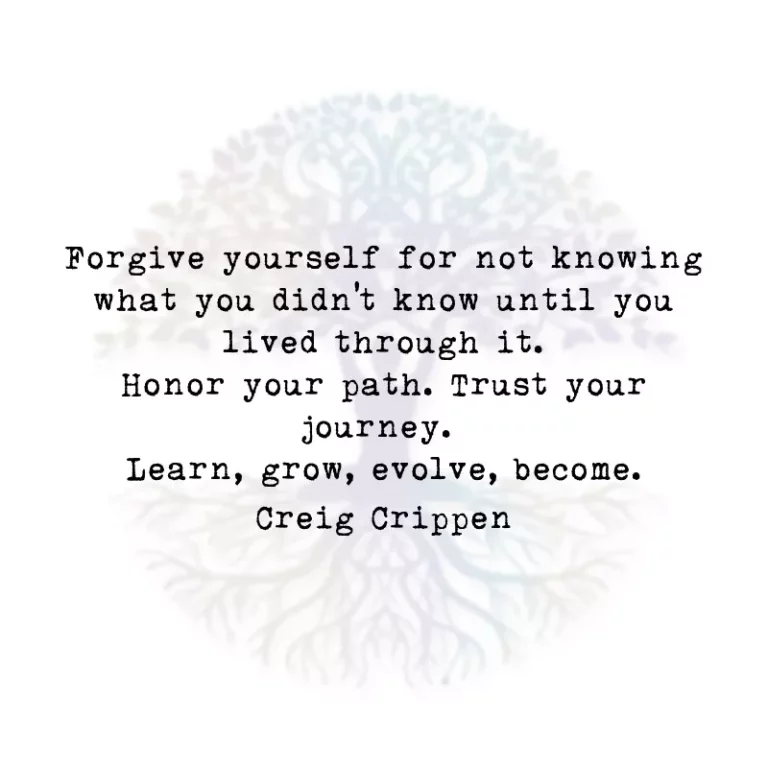
Forgive yourself for not knowing what you didn’t know until you lived through it.
Honor your path. Trust your journey.
Learn, grow, evolve, become.
~ Creig Crippen
Hurt People Hurt People
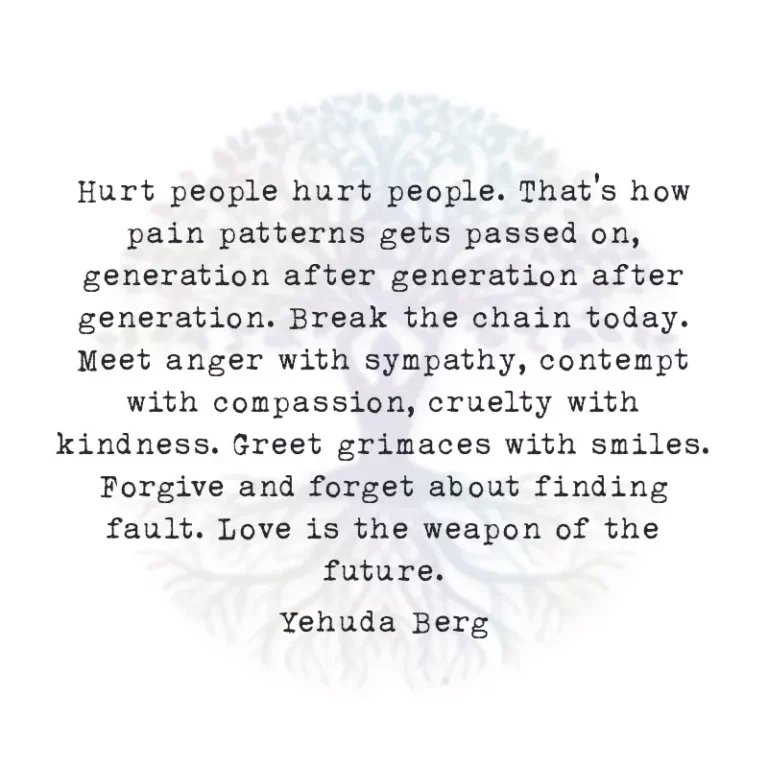
Hurt people hurt people. That’s how pain patterns gets passed on, generation after generation after generation. Break the chain today. Meet anger with sympathy, contempt with compassion, cruelty with kindness. Greet grimaces with smiles. Forgive and forget about finding fault. Love is the weapon of the future.
~ Yehuda Berg
Seeking Shadow’s Gold: Putting the “Quest” Into Questioning

“The less people know, the more stubbornly they know it.” ~ Osho
What is Shadow’s Gold?
We are all born inside a cave. This cave is our conditioned mind. It is reinforced by the society we live in and the culture we were conditioned by. The cave is a psychosocial cul-de-sac buttressed by the rigid walls of cultural conditioning and guarded by dogmatic indoctrination. This is the story of our psychosocial enslavement.
In Plato’s Cave, people don’t know that they don’t know. They are spellbound by the dancing shadows, convinced that is all there is to reality. Only the power of imagination and questioning their perception of reality frees them from the tyranny of a limited reality.
Similarly, the culturally reinforced cave of our mind is spellbound by the blinding light of society. The light is so bright and convincing that we don’t realize it is blinding us from a healthier, less limited, perception of reality.
Indeed. Those unaware that they are blinded by the light will never gain the capacity to seek out their shadow. And those without the capacity for shadow seeking will forever be tormented by a limited reality.
Seeking the shadow is a vitally important part of escaping the psychosocial cave and reconditioning our conditioning. The psychosocial cave is like an inverted Plato’s Cave. Where literal shadows prevent the seer from perceiving more holistically in Plato’s Cave, in the psychosocial cave it is the blinding light that does so.
Where the light of day frees one from Plato’s Cave, the shadow’s gold frees one from the psychosocial cave. In both allegories, to become aware of the cave is to leave it.
Seeking shadow’s gold:
“My abyss speaks. I have turned my ultimate depth into the light.” ~ Nietzsche
The first step in discovering shadow’s gold is to accept that we are blinded by the light. We must accept that we are blinded by the light of our cultural conditioning. That light that’s so incredibly blinding that we cannot even think beyond it.
Once we accept this, we free ourselves to take a leap of courage out of the blinding, overly comfortable, and oh-so-safe, light of Mother Culture. This is especially important when a culture is profoundly sick as ours is.
After the leap of courage, the real journey begins. We are ready to “Quest” into questioning. Our imagination unlocks. Creativity becomes a black fire burning at the center of that blinding light. Somewhere in that fire of darkness is our shadow, dancing.
Why is it dancing? It dances not only because it is fire, but because it is our hidden mischief, our repressed Dionysus, our carefree yet concealed Sisyphus, and our overwhelmed inner child. It dances because it is free to be both fire and darkness, despite fear and light.
Fear fuels the blinding light of our cultural conditioning. Fear is an abstraction of an abstraction that keeps us trapped in our psychosocial cave. Fear blinds us into focusing only on what we think we know (the cave), while keeping us ignorant to the unknown and potentially healthier way of being human in the world (outside the cave).
The shadow dances in the black fire of our creativity, ready to transform boundaries into horizons. It is eager to overcome the cave by turning it inside out. It is primed to flip all scripts, turn all tables, push all envelopes, and transform fear into fearlessness.
This is the power of an awakened shadow. The blinding light is turned inside out, like a black hole collapsing in on itself. Even fear is inverted. And now the black hole of our inside out psychosocial cave can, like a piece of coal, be pressurized into the most precious diamond known to man: shadow’s gold.
Cultivating shadow’s gold:
“I have lived on the lip of insanity, wanting to know reasons, knocking on a door. It opens. I’ve been knocking from the inside.” ~ Rumi

Cultivating shadow’s gold requires maintaining pressure on the “coal” of our inverted psychosocial cave. How do we do that exactly? Through the checks and balancing of a questioning mindset.
This requires vigilance. It requires a ruthless kind of self-questioning known as self-interrogation. We must remain circumspect in our checks and balances lest the gained harmony of the diamond (shadow’s gold) regresses into the disharmony of the coal (inverted psychosocial cave). Or worse, we de-evolve back into the blinding light of our cultural conditioning.
Fueled by our shadow’s dark fire, we are free to dance and play, to branch out and breathe, to stretch our soul across the interconnected cosmos and realize that we were connected all along, we were just blinded by too much light to notice.
We are free to love and to fall in love with Being Love. We are free to unite the abyss and summit inside us, to give our roots wings. For we realize that our shadow’s gold is our broken heart, shattered and hurt from a thousand disappointments and setbacks and failures and shortsightedness and covered in scars, yet more alive, more robust, more anti-fragile because of that fact. Indeed. Our shadow’s gold is our sacred wound glowing like nothing else can glow.
We cultivate our shadow’s gold by dancing with our shadow, by joining our inner light with our inner darkness and casting out a prism of infinite possibilities. We cultivate it by questioning, by keeping the pressure on the diamond. We cultivate it through our imagination, by maintaining curiosity in the face of certainty.
We cultivate our shadow’s gold to stay ahead of the curve. The curve is the rest of society still stuck in the psychosocial cave. We dance, we question, we create, we maintain our awe, for the pure joy of cultivation, but also as a way of living by example. So that our inner fire, our blazing shadow dance, can be seen from the other side.
So that those still caught in the blinding light can perhaps catch a glimpse of our beautiful darkness. And perhaps they will be hooked by the question mark hidden inside all their answers, answers, answers. And perhaps they will begin to actually think outside the box that they so desperately try to think outside of. So that the harmonizing medicine of shadow’s gold can radiate through all the confusion and psychological static inherent in the human condition.
In the end, those few of us who have discovered our shadow’s gold empathize with those still blinded by the light of their cultural conditioning. After all, we were once trapped too. We were once without the empowering fire of our shadow’s gold, living half-lived lives yoked to the mindless stagnation of blind faith enforced by an arbitrary black and white uniformity.
But no longer. Now our inner darkness and inner light shine together. Now, with our shadow’s gold at hand, we are beacons of darkness despite the blinding light.
Image source


