“If you realized how powerful your thoughts are, you would never think a negative thought.” ~ Peace Pilgrim
Our thoughts and intentions manifest into reality. They have the power to change our lives. Even the food prepared with love and positive thoughts would taste better.
Ever wondered why home-made food always tastes better than restaurant food or canned food?
Besides, the use of fresher and possibly more nutritious ingredients, there is another factor that makes home food better – mother’s love and caring intention.
The act of saying few words of gratitude before eating your meals has a positive effect.
Every culture talks about saying positive words before eating – Christians say grace before their meals, Hindus chant a prayer and sprinkle water around it, Muslims also start eating only after chanting the name of the Divine.
An experiment carried out by scientists at the Institute of Noetic Sciences, examined the roles of intention and belief on mood while drinking tea.
It explored whether drinking tea “treated” with good intentions would have an effect on mood more so than drinking ordinary tea.
They concluded that tea treated with good intentions improved mood more than ordinary tea derived from the same source.
The study stated, “This also suggests that the esthetic and intentional qualities associated with the traditional tea ceremony may have subtle influences that extend beyond the ritual itself.”
We know the power of thoughts and intentions on water; water stamped with positive words was far more symmetrical and aesthetically pleasing than that stamped with dark, negative phrases.
With the money-driven lifestyle, we forget what kind of effect thoughts can have on us and our surroundings.
Be mindful; before you eat, or drink water, be thankful for it.
Put love and good intentions into everything you consume, as this will have a direct effect on your physical body.
Following such a simple practice can lead to a better life and healthier living.
Here’s a short and simple universal meal time songs to teach your children 🙂
Masaru Emoto discovered that if thoughts and words are directed at water, the water crystals undergo changes depending upon whether the words or thoughts are positive or negative.
Positive thoughts lead to changes in the water crystals that make some of them look like fractals and snow flakes while negative thoughts make the water look distorted.
Emoto’s work has been published in his book, “The Message from Water,” it provides evidence that human vibrational energy, thoughts words, ideas and music affect the molecular structure of the water crystal.
One of the most interesting examples of his was the water from the Fujiwara Dam, before and after receiving a prayer from a Zen Buddhist Monk.
We already understand that water is quite malleable, that means it easily takes new physical forms as per the environment it is in, like water in the can takes the shape of the can etc. But we can’t see the molecular structure of it and just like its physical form the molecular form adapts to the environment.
Masaru has documented the changes that water undergoes through environmental stimuli by freezing droplets of water and examining them with a dark field microscope that can take pictures.
Lets take a look at some of his work, I have put a video below that consists of an interview, the way water reacts to particular words and a water molecule responding to Beethoven’s Symphony No. 9.
Alright from the above video you would have realised that the scientific community does not hold any weight for his experiment because it was not performed using certain standards. So he’s given you a little experiment at the end of the video.
Here’s a couple who decided to try the experiment with the words, “Thank You” and the words “You Fool” with rice in the jar, the first video is the preparation and the second video is the results of the rice 30 days later.
Very interesting isn’t it, our thoughts and words are extremely powerful so when people say think positive, you now know it has a much better effect. Thinking positive is not just one positive thought surrounded by hundreds of negative thoughts.
But positive thoughts not only affect water it can change our entire world, especially when you consider we are 55% – 78% water, and mother earth is covered with 60% of water. So think positive, feel good and live a happy life!
The holographic universe is a book by Michael Talbot, (1953-1992), he was also the author of a number of books highlighting parallels between ancient mysticism and quantum mechanics, and espousing a theoretical model of reality that suggests the physical universe is akin to a giant hologram.
The main architects of this astonishing idea were two eminent thinkers, the first one was David Bohm, a protege of Einstein, physicist in the University of London and one of the world’s most respected quantum physicists. The second was Karl Pribram, a neurophysiologist at Stanford University and author of the classic neuropsychological textbook Languages of the Brain.
The most interesting part is both Bohm and Pribram worked in two different fields and arrived at the same conclusion from two very different directions. Bohm became convinced of the universe’s holographic nature only after years of dissatisfaction with standard theories’ inability to explain all of the phenomena encountered in quantum physics.
Pribram became convinced because of the failure of standard theories of the brain to explain various neurophysiological puzzles. Anyway, enough of that talk its kind of difficult to understand these principles when you have not experienced shifts in the space time continuum in your head.
These two videos will explain the part of the holographic universe and how our brain perceives, its a very well made video to enable understanding of these principles.
Earlier I had written on a Conscious and Participatory universe, where we had quoted Gregg Braden, and included a couple of his interviews, this video bridges the gap in understanding our place in the holographic universe.
The experiment that kick started the entire concept of the holographic universe was Alain Aspects’ in 1982 at the University of Paris related to the EPR Experiment, a consciousness experiment which had been devised by Albert Einstein, and his colleagues, Poldlsky and Rosen, in order to disprove Quantum Mechanics on the basis of the Pauli Exclusion Principle contradicting Special Relativity.
Aspect and his team discovered that under certain circumstances subatomic particles such as electrons are able to instantaneously communicate with each other regardless of the distance separating them. It doesn’t matter whether they are 10 feet or 10 billion miles apart. Somehow each particle always seems to know what the other is doing.
The problem with this feat is that it violates Einstein’s long-held tenet that no communication can travel faster than the speed of light. Since traveling faster than the speed of light is tantamount to breaking the time barrier, this daunting prospect has caused some physicists to try to come up with elaborate ways to explain Aspect’s findings. But it has inspired others to offer even more radical explanations.
An experiment in 1993 that has been forgotten was brought to light by the movie What the Bleep do We Know? The excerpt below is taken from that movie, and it got us thinking.
Even the material world around us the chairs, the tables, the rooms,the carpet all of these are nothing but possible movements of consciousness. And I’m choosing moment to moment out of those movements to bring my actual experience into manifestation. This is the only radical thinking that you need to do. But it is so radical It’s so difficult because our tendency is that the world is already out there independent of my experience. It is not. Quantum physics has been so clear about it.
So we are not just observers! Collectively we have the power to bring about changes with just our thoughts! Yes, it has been scientifically validated with the positive effect of meditation on crime. A two-month long transcendental meditation experiment was done in Washington, DC in 1993 to reduce violent crime.
The Transcendental Meditation (TM) technique, introduced by Maharishi Yogi, is a simple, natural, effortless procedure whereby the mind easily and naturally arrives at the source of thought, the settled state of the mind — Transcendental Consciousness — pure consciousness, self-referral consciousness, which is the source of all creative processes.
In Washington DC, the so-called murder capital of the world there was a big experiment in the summer of 1993 where volunteers came from a hundred countries to collectively meditate for long periods of time throughout the day. It was predicted in advance that with such a sized group you would have a certain percentage drop in violent crime as defined by the F.B.I. in Washington that summer.
Well, the chief of police went on television saying that “Look. It’s gonna take two feet of snow to reduce crime by that percentage in Washington, DC this summer.”
But by the end, the police department became a collaborator and author of this study because the results in fact showed a percentage drop in violent crime in Washington, DC which we could predict on the basis of previous studies that had already been done on a smaller scale. Are people affecting the world of reality that they see?
We wanted to do some research on the effects of meditation on crime, and found these interesting facts. This National Demonstration Project to Reduce Violent Crime and Improve Governmental Effectiveness brought approximately 4,000 participants in the Transcendental Meditation and TM-Sidhi programs to the United States national capital from June 7 to July 30, 1993.
A 27-member independent Project Review Board consisting of sociologists and criminologists from leading universities, representatives from the police department and government monitored its progress.
Using time series analysis, violent crimes were analyzed separately in terms of HRA crimes (crimes against the person) and robberies, as well as together. The maximum decrease was 23.3% when the size of the group was largest during the final week of the project.
Based on the results of the study, the steady state gain (long-term effect) associated with a permanent group of 4,000 participants in the Transcendental Meditation and TM-Sidhi programs was calculated as a 48% reduction in HRA crimes in the District of Columbia.
A very interesting experiment that teaches us that each one of us have the power to affect our surroundings in a positive way, you can read the entire experiment report here.
We love the Tibetans, a race showcasing profound understanding of mortal and life beyond death. In a previous piece we spoke about the Tibetan bowl, we still encounter that experience, but today we shall talk about something that may be tough to understand by many, the Tibetan funeral process.
The most common methods for deceased bodies after death is burial and cremation. While the Zoroastrians have a slightly different method, where the body is fed to the birds which is considered a good deed and the bones are discarded in a well. The Tibetan Sky Burial is somewhat similar, lets take a look at how it works.
Majority of Tibetans adhere to Buddhism, which teaches reincarnation, hence there is no need to preserve the body, as the body is only a vessel. Once a person dies the vessel is empty, the Birds may eat it, or nature may let it decompose. The function of the sky burial is simply the disposal of the remains.
The corpse is cut into small pieces and placed on a mountaintop to feed the birds of prey, in Tibetan the practice is known as jhator, that literally means, “giving alms to the birds.” As much of Tibet the ground is too hard and rocky to dig a grave, and with fuel and timber scarce, a sky burial is often more practical than cremation.
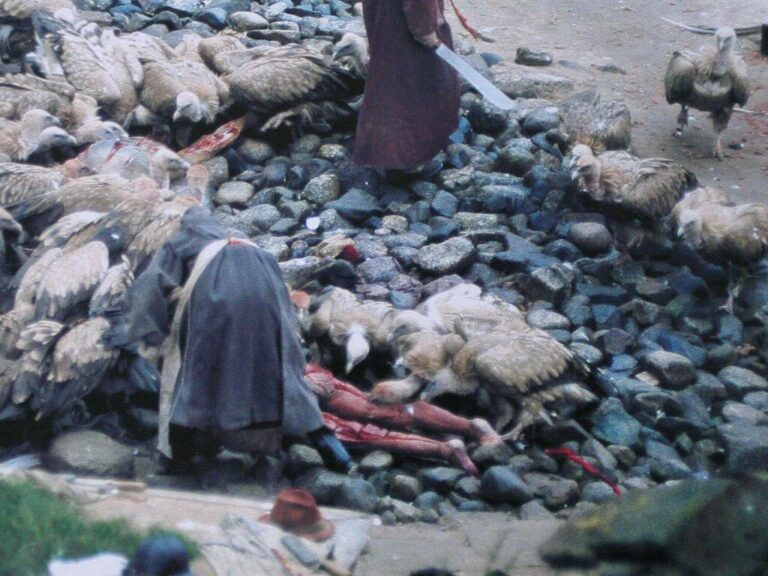
Vultures fighting over the flesh
The government of the People’s Republic of China, which has forcibly occupied Tibet since 1950, prohibited the practice that they consider barbaric in the 1960s. They started to allow it again in the 1980s, perhaps after realizing they would save on resources via the Sky Burials.
A traditional jhator is performed in specified locations in Tibet, the Drigung Monastery is one of the three most important jhator sites. The procedure takes place on a large flat rock long used for the purpose and is always higher than its surroundings. Relatives may remain nearby during the jhator that usually takes place at dawn.
Prior to the procedure, monks may chant mantra around the body and burn juniper incense. The work of disassembling of the body may be done by a monk, or, more commonly, by rogyapas (“body-breakers”).
Men in long white aprons come out, and unwrap the corpse, which is naked, stiff, and swollen. The men hold huge cleavers, which are in a few strokes whetted to razor sharpness on nearby rocks. The bright sun and clear blue sky diffuse somewhat my ominous feeling. The coroners themselves, are not heavy or ceremonial, but completely businesslike as they chat amongst themselves, and prepare to start.
Tibetans believe that, more important than the body, is the spirit of the deceased. Following death, the body should not be touched for three days, except possibly at the crown of the head, through which the consciousness, or namshe, exits. Lamas guide the spirit in a series of prayers that last for seven weeks, as the person makes their way through the bardo–intermediate states that precede rebirth.
As the first cut is made, the vultures crowd closer; but three men with long sticks wave them away. Within a few minutes the dead man’s organs are removed and set aside for later, separate disposal. The vultures try to move in and are prevented by waving sticks and shouts. Then, the cutters give a signal and the men all simultaneously fall back.
The flock rushes in, covering the body completely, their heads disappearing as they bend down to tear away bits of flesh. They are enormous birds, with wings spanning more than 2 meters, top-feathers of dirty white, and huge gray-brown backs. Their heads are virtually featherless, so as not to impede the bird when reaching into a body to feed.
Crushing the bones
For thirteen minutes the vultures are in a feeding frenzy. The only sound is tearing flesh and chittering as they compete for the best bits. The birds are gradually sated, and some take to the air, their huge wings sounding like steam locomotives as they flap overhead. Now the men pull out what remains of the corpse, only a bloody skeleton and shoo away the remaining birds. They take out huge mallets, and set to work pounding the bones. The men talk while they work, even laughing sometimes, for according to Tibetan belief the mortal remains are merely an empty vessel. The dead man’s spirit is gone, its fate to be decided by karma accumulated through all past lives.
The bones are soon reduced to splinters, mixed with barley flour and then thrown to crows and hawks, who have been waiting their turn. Remaining vultures grab slabs of softened gristle and greedily devour them. Half an hour later, the body has completely disappeared. The men leave also, their day’s work finished. Soon, the hilltop is restored to serenity. I think of the man whose flesh is now soaring over the mountains, and decide that, if I happen to die on the high plateau, I wouldn’t mind following him.


 Besides, the use of fresher and possibly more nutritious ingredients, there is another factor that makes home food better – mother’s love and caring intention.