Home Blog Page 294

Surpassing Mentors and Escaping the Master’s Shadow

1

standing-on-Shoulders-Of-Giants

“It is good to remember that the goal of Buddhism is to create Buddhas, not Buddhists, as the goal of Christianity is to create Christs, not Christians. In the same vein, my teachings are not meant to acquire followers or imitators, but to awaken beings to eternal truth and thus to awakened life and living.” –Adyashanti

Standing on the shoulders of giants is very important, but remaining stuck there can lead to impotence. If we remain on the giant’s shoulder we can only see as far as the giant sees, but if we get creative and climb atop the giants head, or build our own platform to climb even higher, we can see further, and farther, than they ever could. The way to transform boundaries into horizons is to constantly question what the masters of a given boundary are declaring as truth. Play with the “truth.” Juggle it. Smash it at your feet. Then put it back together again, this time instilled with more flexibility.

Learn their way of handling it. Just remember to do it your way afterward. Tweak their way. Twist it into a more elegant form. Tug at it until it becomes taut with refinement. Then pass it on to a student and encourage them to do the same. Like Robert Greene wrote in his book Mastery: “Choose the mentor who best fits your needs and connects to your Life’s Task. Once you have internalized their knowledge, you must move on and never remain in their shadow. Your goal is always to surpass your mentors in mastery and brilliance.”

The problem with mastery is the finality of it. The problem with mastery is that the goal has been achieved and the journey is no longer the thing. Remember: the journey must always be the thing, otherwise the adventure is over and complacency and stagnation become rulers over our life. The reason we kill Buddha on the path is exactly because of this complacency. A master becomes complacent because he or she becomes too comfortable with their achieved goal and the fame and accolades that come along with it. Put simply: too much comfort makes us soft. Indeed, too much comfort actually kills the journey.

Whats-lurking-in-the-shadows-at-Perish

The reason why so many Christians are not Christ-like, and so many Buddhists are not Buddha-like, is exactly because of the comfort that their religion brings them. They are so bewitched by the coziness of convention and relief from shame and grief and “sin” that they believe they never have to worry about anything. They feel safe on their crutches, even as they lean into the unknown. But, and here’s the rub, the journey is the thing exactly because it’s uncomfortable and challenging and difficult to navigate.

The journey is the thing exactly because it isn’t a groundless consolation or unfounded reassurance. The journey is adventurous exactly because of the unknown. Eventually you have to toss those crutches aside and discover your own way in order for the journey to continue. Besides, the burden and joy of figuring it out for ourselves, of really being accountable and responsible for our own direction in life, is exactly what transforms us into masters like Christ and Buddha.

The only way we evolve as a species is to learn from the mentors who came before us, internalize their knowledge, and then move on with our own journey even as we discover new ways that make their ways obsolete. Like James Russell Lowell said, “Time makes ancient good uncouth.” This applies to what we learn from our mentors as well. This even applies to our own mastery. If enough time passes by even the “good” that came from our own mastery of a thing can eventually become uncouth. This is because the only absolute in the universe is change. The only permanent is impermanence. Nothing remains the same. Even Truth is a chameleon. This is why the best mentors have an unwavering sense of humor.

Buddha-simple-drawing

“If your mind is empty,” writes Shunryu Suzuki, “it is always ready for anything, it is open to everything. In the beginner’s mind there are many possibilities, but in the expert’s mind there are few.” Cultivating beginner’s mind is important for escaping the shadow of mastery, whether it’s our mentor’s shadow or our own. The master’s mind turned beginner’s mind is what I call the New-layman.

New-laymen escape the shadow of their own mastery and create for themselves a freedom for new creating. They realize that learning is not linear, but cyclical. It’s not about accumulating information and mastering it, but about internalizing the relationships between information and then synergizing the experience into recyclable mastery. They don’t seek followers to teach, they seek leaders with the hunger to learn. Think Christ. Think Buddha. Think Gandhi. Think Nietzsche.

At the end of the day, mastery, like enlightenment, is an illusion. It’s a stopgap at best, a reverse speed-bump on the path, or maybe a ramp that launches us over certain obstacles. But the path is still the path. The journey is still the thing. No amount of so-called mastery can change the fact that change is the only absolute. And so the ability to adapt and overcome becomes paramount. Learning from our mentors is adapting. Escaping the shadow of our mentors is overcoming. And the “journey being the thing” rolls on.

Like the Zen proverb states, “Let go, or be dragged.” We “let go” by moving on smartly with what our mentors taught us so that we don’t “get dragged” by complacency and comfort. We don’t become masters by standing on firm ground and having fixed conviction about what we’ve been taught. We become masters by having the courage to question and improve upon what our mentors taught us, so that we can adapt and overcome the vicissitudes of life. Like the great Alan Watts brilliantly opined, “For what one needs in this universe is not certainty but the courage and nerve of the gambler; not fixed conviction but adaptability; not firm ground whereupon to stand but skill in swimming.”

http://youtu.be/QCOVusLqXmk
Shoulders of giants

Shadow Illusion

Simple Buddha

4 Ways One Can Become a Better Lightworker

In a dark world, the beacon shines brightest. Have no illusions, we live in a dark world. But that’s all the more reason to shine your light.

Flash it with ruthless abandon. Let it sparkle and glitter and gleam with merciless luster. If not you, then who? Imagine the world is a dark and stormy ocean. You are the lighthouse that will guide in the wayfaring ships.

Here then are four simple ways to become a better lightworker…

Be Vulnerable

“To be human is necessarily to be a vulnerable risk-taker; to be a courageous human is to be good at it.” ~ Jonathan Lear

Be open and honest. It will connect you to all things. Instead of trying to possess Truth; let yourself be possessed by it. If you’re too rigid and closed-off, Truth will elude you forever. You want to discover the truth?

Then you’ve got to be more vulnerable. You want to be a beacon of hope for others? Then you’ve got to be more open. The myth of courage is that it implies invulnerability. The myth of strength is that it implies hardness.

Courage is not being invulnerable. Strength is not an unwavering hardness. It is a soft plasticity. There is strength in absolute vulnerability that those with invulnerable power will never know.

Like Dan Millman wrote, “The peaceful warrior’s way is not about invulnerability, but absolute vulnerability.”

Don’t be a stiff knight in rigid armor; be a flexible Bruce Lee in naked vulnerability. Practice Namaste: introduce the god within yourself to the god within others. Your courage will be a beacon of hope that has the potential to transform victims into warriors.

Be Weird

“When you are truly genuine, there will invariably be people who do not accept you. And in that case, you must be your own badass self, without apology.” ~ Katie Goodman

Be strange. Be odd. Be bizarre. Be uncanny. It will make you stronger. It will bring you strength in between the lines drawn by culture. Cultural paradigms are almost always platitudes. Shirk them with a humor of the most high.

Be the gadfly in the ointment. Be the sacred clown in the midst of self-serious corporatists in banal business suits and overzealous priests in parochial garb. Rules are meant to be broken so that new and better rules can be actualized.

Be a Divine Lawbreaker. Be a Spiritual Gangster. Be a Transcendent Delinquent. The world needs you to shine your perfectly imperfect light. Shine it into the eyes of everyone seeking perfection. Blind those who preach pigeonholed truth.

If you should meet Buddha on the path, blind him with your unique-as-your-own-fingerprint light. Your courage will be a beacon of hope that has the potential to transform boundaries into horizons.

universe-is-in-you

Be Your Shadow

“One of the least discussed issues of individuation is that as one shines light into the dark of the psyche as strongly as one can, the shadows, where the light is not, grow even darker.” ~ Clarissa Pinkola Estes

Get in touch with your dark-side. It will keep you whole. Don’t deny your shadow, play with it instead. Reconcile with it. One should not shun the shadow for fear of being immoral. The secret of alchemy is the intimacy of perceived opposites.

Shadow work is light work. You want to transform lead into gold; shadow into light; demon into daemon; unconsciousness into consciousness; pain into healing; fear into courage; victim into warrior? Then undeceive yourself.

Realize that your inner-darkness is where your light needs to shine the brightest. Compassionate empathy with the world requires a baptizing of our inner-shadow, lest we demonize the shadows of others.

Like Loius G. Herman wrote, “By accepting the inevitability of our shadow, we recognize that we are also what we are not. This humbling recognition restrains us from the madness of trying to eliminate those we hate and fear in the world. Self-mastery, maturity, and wisdom are defined by our ability to hold the tension between opposites.”

Be Creative

“Where I create, there am I true.” ~ Rainer Maria Rilke

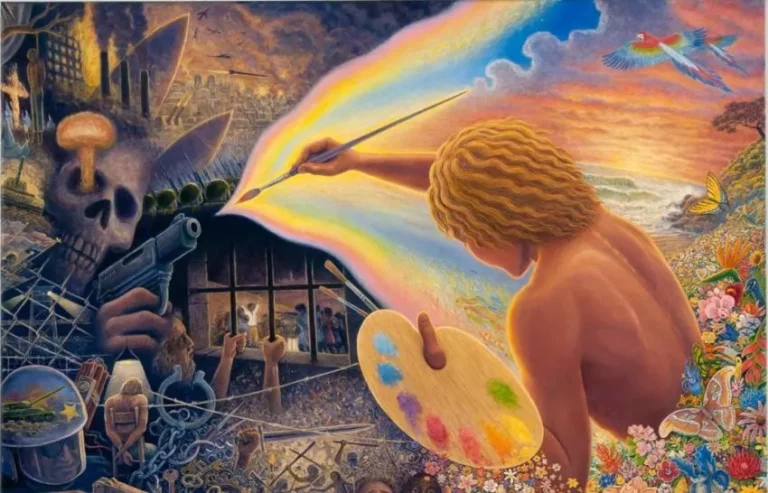
Be artistic. Be proactive with your imagination. It will set you free. The creative process is the liberation of the soul.

If, as Thomas Berry said, “The only viable option for the universe is for it to be in a state of creative disequilibrium, holding together sufficiently to not fall apart, but open enough to be expanding,” and we are all just emergent aspects of the cosmos perceiving itself anyway, then the only viable option for human beings, especially for artists, is to also be in a state of creative disequilibrium, holding together sufficiently to not fall apart, but open enough to keep expanding.

You want to be a lighthouse for others? Be creative. Shine your art into all the artless places of the world. Be the walking personification of a pen defeating a sword.

We are all ordinary human beings having an extraordinary experience. The creative process is simply a way to actualize the extraordinary. Every single artistic act is an act of actualizing the extraordinary.

It puts us square in the moment like nothing else.

Like Socrates asked Dan Millman in The Way of the Peaceful Warrior: “Where are you? Here. What time is it? Now. What are you? This moment.”

This kind of understanding can only come from experiencing the creative process. Whether it’s the experience of being “in the zone” like in sports and play, or the “flow state” like in writing and painting, when the creative power of the self becomes conscious it exhibits uncanny ecstasy with the current moment.

This state of higher creativity is exponentially divine and the source of all meaning.

Like Eckart Tolle wrote in A New Earth: “When the creative power of the universe becomes conscious of itself, it manifests as joy. You don’t have to wait for something “meaningful” to come into your life so that you can finally enjoy what you do. There is more meaning in joy than you will ever need. The “waiting to start living” is one of the most common delusions of the unconscious state. Expansion and positive change is more likely to come into your life if you can enjoy what you are doing already, instead of waiting for some change so you can start enjoying what you do.”

Image source:

Art by Mark Henson
Cosmic cloak

Are You Moving Towards the Life You Want or Away From It?

“Life is truly what you make it. The purpose and meaning of life is the purpose and meaning that you give it” ~ Steven Redhead

Life doesn’t come with a rule book. With over 7 billion people living on earth, it would be impossible to determine a one size fits all formula for success and happiness.

The ironic thing is, while most people don’t doubt that everyone’s definition of happiness is different, they still seem to be willing to sacrifice their own version of happiness in order to fit in with society’s version, or the version that their parents lived.

Many people are just going through the motions. As long as there is a paycheck coming in, they don’t think too much about what they really want out of life. They are content at just making a living.

Unfortunately, in this quest to just make a living, many people forget how to make a life. In order to discover our own personal formula for how to make a life for ourselves, it is important for us to focus on one question: “What is my purpose?”

live-the-life-you-dreamtThis question may be harder to answer than we think. It forces us to become self-aware which can not only be uncomfortable, but also difficult considering most of our decisions are happening so automatically that we don’t even realize the “why” behind them.

However hard it may be, by doing this we allow ourselves to take a more active role in how our life will go instead of sitting back and watching it pass by.

Here are some important questions to ask yourself to help you determine whether you are ultimately working towards your version of a life you want:

1) How do I define Success?

The definition of success will vary widely amongst people and cultures, but it is important to determine whether or not we are relying on external factors to determine our success or internal factors. While it is not wrong or “bad” to desire financial abundance, or a big home or an expensive car, it is important not to depend on these things in order to feel “successful”.

Truly successful people know that health of mind/body/spirit is the true mark of a successful person, because with health in these three areas, they know they are happy. Happiness will naturally attract to us a job that we love, which will make us more prone to financial abundance, if that is what we desire.

2) What is my purpose for wanting a relationship?

purpose-of-life In order to attract a healthy relationship, we must examine the reason behind the desire for one. Many people make the mistake of trying to escape loneliness as the reason or maybe they think they need validation from another person.

Either way, they open themselves up to a quantity over quality issue, which usually ends in disappointment. The happiest and healthiest of relationships start with two people who feel whole and complete on their own and decide to start building a life with each other because they actually enjoy one another’s company.

When the purpose of the relationship is to enhance an already happy existence instead of filling some sort of void, we find that we only stay in relationships that are aiding in our self-growth. The purpose behind the relationship becomes more about companionship instead of co-dependency.

3) Do I have a vision for how I want my life to be?

To have a vision or a goal of how we want our life to ultimately be will help us out tremendously. It makes the everyday grind much more tolerable. For example, a person may have to work at a job they don’t truly love for a while but when they know deep down they are working towards their ultimate goal of let’s say, being an actor, they won’t begrudge their day job so much.

They know deep down that they only are doing this job until they get their big break so the mundane job they have now doesn’t seem so terrible. When we set a vision for our lives we subconsciously start working towards it every day.

You can write down what your vision is for your ultimate dream life or even create a vision board that you look at daily, once you know WHAT you are working towards you, the HOW will start to reveal itself. Also, you will start to feel excited about getting there as opposed to just working mindlessly with no end in sight.

4) Am I doing things because I want to do them, or because I have to do them?

live-life-you-have-imagined It may sound selfish to only do things you WANT to do, but it’s actually the best thing you can ever do for yourself and the people around you.

When the purpose is fear, for example, “I’ll do this because I’m afraid so and so will be mad at me if I don’t” or “I’m afraid of how I will look to someone else if I say no, so I’ll just do whatever they want me to do,” we live a life that is not genuine.

We start being a people pleaser instead of paying attention to our own individual needs. However, when we start engaging only in activities that we truly want to do, or that will bring us joy, we allow other people in our lives the freedom to do the same.

Suddenly we find ourselves surrounded by friendships and relationships with people who actually want to be there for us, or help us out instead of people who are doing it out of obligation. Conversely we do the same. We start to help and be there for our friends because we get genuine joy out of it, instead of just doing it because we feel guilty not to.

An examined life is the best way to go about working towards our goals. If we have no inkling as to the reasons behind our behaviors how can we ever expect to change them?

When we do start to bring awareness into our day to day actions we find that we hold the key to our own happiness. Yes it will require constant mindfulness and questioning of ourselves but in the end we will constantly be working towards the life we want instead of in the other direction.

“Go confidently in the direction of your dreams! Live the life you’ve imagined. As you simplify your life, the laws of the universe will be simpler.” ~ Henry David Thoreau

Image Source

Life

10 Buddha Mudras to Practice in Daily Life

Mudras or hand gestures is a practice to improve your physical, mental and spiritual well-being. In the Vedic tradition, the fingers of the hand represent the five basic elements that make up the human body: air, fire, water, earth and ether. Based on this understanding, finger tips of living beings have many concentrated nerve root endings which act as free energy discharge points.

On touching the finger tips together in different ways or to other parts of the palm channelizes and balances the flow of energy (Prana) within our body, and the energy traveling through the nerves stimulates the various chakras.

In Sanskrit, mudra literally means a posture/seal and has been used in different religions, art and dance forms, yoga and meditation for a long time.mainIn yoga, using mudras in conjunction with Pranayama (breathing exercises), revitalizes the flow of energy to different parts of the body. While Tibetan Buddhism, Zen Buddhism, Theravada Buddhism and Mahayana Buddhism broadly use mudras during mindful meditation.

Let’s take a look at ten important mudras incorporateKarana mudrad by Buddha on his journey to enlightenment. You must have come across a Buddha statue somewhere in one of these mudras. As mudras have healing benefits on the mind and soul, you can generally perform these to instantly energise yourself.

1) Karana Mudra

This mudra keeps negativity at bay. To perform this Mudra, stretch your hand either vertically or horizontally. Turn the palm forward. Now using your thumb press down the two middle fingers and extend the index and little finger straight upwards.

Energy created by performing this mudra helps in expelling negativity from your mind and soul.

varada2) Varada Mudra

This gesture signifies offering, welcome, charity, giving, compassion and sincerity. It is a left hand gesture in which the arm is hanging naturally at the side of the body and the palm facing outward, and the fingers extended.

3) Uttarabodhi Mudra

It signifies supreme enlightenment as it charges one with positive energy and vibrations. The mudra helps one in staying connected with oneself and the divine universal energy.

In order to perform this Mudra, both hands are placed at the heart; index fingers touching and pointing upwards and the remaining fingers intertwined. Try holding the Uttarabodhi mudra for a couple minutes and feel the subtle energy shift in your body.uutarbodhi

4) Namaskara or Anjali Mudra

Namaskara mudra is used in Indian culture to greet people and as a sign of respect. This Mudra is performed by pressing the palms together and holding it to the center of the chest or the heart chakra; fingers pointing towards the sky.

The mudra evokes positive vibrations in the body teaching us the fact that we are all one and we must acknowledge/adore the existence of light in one another. This Mudra helps in staying grounded and humble. Anjali

5) Vitarka Mudra

This mudra evokes the energy of teaching and intellectual discussion, or argument. In this gesture tips of the thumb and index finger touch to form a circle that creates a constant flow of energy and information. All the other fingers are extended upwards. This Mudra gives us the energy required to attain clarity of mind. vitarka

6) Abhay mudra

Abhay is translated as fearlessness. In this Mudra, the right hand is brought to the shoulder level and the palm faces outward and fingers extend upwards. History says that when Buddha was attacked by an elephant, he used  this mudra to stop the flow of negative energy (fear). This Mudra gives us the energy to stand strong. OLYMPUS DIGITAL CAMERA

7) Dhyana mudra

This mudra depicts absolute concentration in the process of meditation. Place both your hands on the lap with the right hand placed on the left and fingers fully stretched, palms facing outwards; thumbs of both the hands will touch creating a triangle, cleansing of any impurities on an etheric level. Practicing this Mudra will fill you with deep sense of peace and serenity. Dhyana mudra

8) Bhumisparsha mudra

Bhumisparsha translates to touching the earth where the mudra symbolizes the fact that the earth witnessed Buddha’s enlightenment under the Bodhi tree. This was the Hand gesture of Buddha when he accomplished Enlightenment. In this Mudra, the right arm hangs over the right knee with the right palm turned inward and the left hand is placed on the lap with the left palm faced upwards. Bhumisparsha

9) Vajradhara mudra

In this mudra the wrists are crossed, over the heart, with the right forearm placed in front of the left one; this gesture symbolizes the highest energy and the union of compassion and wisdom necessary to reach enlightenment. In vajradhara mudra, one is free from  judgement, notions, theories, fate, truth and any concept that defines enlightenment; as they say, enlightenment is not defining it. vajradhara

10) Dharmachakra Mudra

Depicts the continuous flow of energy in the cosmos. Here the hand gesture symbolizes the energy of the universe in the form of a chakra/wheel. Both the hands are placed near the chest, the left palm faces the heart and right palm faces outwards; index finger and thumb form a circle like Vitarka mudra. This mudra represents the whole universe in a nutshell. Dharmachakra As I mentioned before, these Mudras are used in the process of mindful meditation. But at the same time one can practice these mudras to gain the simple benefits of altering one’s state of consciousness and staying positively energized.

“Our essential nature is boundless consciousness. We are rooted in it when the mind focuses and settles.” – Yoga Sutras

Image Source 1) 2) 3) 4) 5) 6) 7) 9) 11)  

Sacred Activism and the Lighting of the Third Fire

4

“Sacred activism is the fusion of the mystic’s passion for God with the activist’s passion for justice — creating a third fire, which is the burning sacred heart that longs to help, preserve, and nurture every living thing.” ~ Andrew Harvey

In a world of unholy wars dubbed holy wars and media claptrap passed as truth, there has never been a more important time to rise above the hogwash of the status quo. We are everywhere surrounded by fraudulence. We are immersed in the pink goop of the Matrix to such an extent that we can’t even see the forest for the trees.

What’s needed is a self-inflicted rude awakening. What’s needed is a wake-up call of the first order. What’s needed is a tapping of the cornerstone of the human condition itself. And the music resonating from such a tapping is a song of freedom, and sacred activism is its magnificent dance.

As it stands, we need to relearn how to dance this particular unpopular dance lest the music stop forever. Sacred activism is unpopular because it’s uncomfortable. It’s unpopular because it takes courage. It’s unpopular because it requires us getting off our butts and questioning everyone and everything, especially so-called “fixed” laws and “entrenched” power structures.

That which is deep-rooted must be un-rooted in order for healthy roots to grow. That which is well-established must be reestablished in order for healthy establishment to occur. That which is preconditioned must be reconditioned in order that healthy conditions may arise.

This requires activism. This requires insurgency. This requires rebellion.

Like Rainer Maria Rilke said, “Everywhere transience is plunging into the depths of being… It is our task to imprint this temporary, perishable earth into ourselves so deeply, so painfully and passionately, that its essence can rise again, “invisibly,” inside us. We are the bees of the invisible. We wildly collect the honey of the visible, to store it in the great golden hive of the invisible.”

activism

I often tell people, “I’m a force of nature first, a man second.” And they scratch their heads wondering what on earth I could mean by such a strange statement. I mean exactly what Rainer Maria Rilke said in his quote.

The essence of the earth has indeed risen again. It has risen inside me. It has the potential to rise inside you, as it resides within us all. And it must be unleashed, “painfully and passionately” lest things – bees; oceans; monarch butterflies; us – collapse into an unhealthy state of existence.

This is the essence of sacred activism. This is the lighting of the third fire: each of us realizing that we are a force of nature first and a person second. Once we get the “cart in front of the horse” then we can begin the difficult task of figuring out who we are as a person and what our unique (as unique as our fingerprint) contribution to nature really is.

Like David Spangler said, “The spirituality of the earth is more than a slogan. It is an invitation to initiation, to the death of what we have been and the birth of something new.”

awakening

But, figuring out who we truly are is no walk in the park. It requires practicing self-interrogation. It requires a particular flavor of ruthlessness toward ideals that most people fear. The more we question ourselves, the more we discover exactly how limiting our worldview is.

But once we’re able to question ourselves to the nth degree, then we liberate ourselves from our own self-stagnation and we then free ourselves to question the world.

Like Rob Brezsny wrote in his book Pronoia, “The revolution begins at home. If you overthrow yourself again and again, you might earn the right to overthrow the rest of us.”

As such, we need to get in each other’s faces (just be sincere). We need to stir any and all unstirred pots. For every ointment we come across without a fly in it, we need to BE that fly –a gadfly, perhaps.

Whatever our medium may be –writing, acting, directing, painting, sculpting, comedy, or just plain activism– we need to get in the face of entrenched power structures, growling and snarling, and show them that the third fire has indeed been lit.

Like George Santayana said, “A man is morally free when he judges the world, and judges other men, with uncompromising sincerity.”

And this should not just be an aim, but an obligation to truth and justice the world over. Authentic sincerity does not imply seriousness. In order to be genuine we need to be sincere rather than serious with each other.

This requires elegance in the handling of our fragile human condition, but also an understanding of Nassim Nicholas Taleb’s antifragility and how many things in life benefit from disorder, volatility, and turmoil. From the deepest wounds can arise the greatest wisdom.

Through our mistakes we can become wise, but first we have to learn from them. We only learn from our mistakes by keeping each other accountable, and for that we need sincerity through activism, otherwise we doom ourselves to repeating the mistakes of our forefathers.

Like Mark Twain said, “History does not repeat itself, but it does rhyme.”

apocaloptimist

The lighting of the third fire is the awakening of our own sacred activism. It is a switch inside us all. It’s a potential bonfire inside every heart. A few of us have already collected the kindling necessary for this sacred fire to burn, but many of us have not. It is the duty of those who already have the capacity to light fires, to light the fire of others.

That’s what Albert Camus meant when he said, “I rebel; therefore we exist.”

Each and every act of sacred activism is a lighting of another fire. We’re all candles in the wind. Most of us aren’t strong enough to keep our fires lit in the current maelstrom. Some of us are. And those of us who are should be blocking the wind at least long enough for others to light their fire and to keep it lit, because the wind is only going to get stronger. It is my conceit that this article is just such a windbreaker.

Like the immortal Tolstoy brilliantly opined, “Just as one candle lights another and can light thousands of other candles, so one heart illuminates another and can illuminate thousands of other hearts.”

Apocaloptimists everywhere, may your heart forever be illuminated.

Image Source

Tolstoy quote
Yin yang tree
Apocaloptimist