Home Blog Page 325

LSD & Its Usage in Human Life and Evolution

19

The funny part about LSD is that Albert Hofmann, the scientist who discovered it, claims that LSD discovered him. Although post the discovery of LSD, with the mass usage of LSD in the psychedelic sixties he started to believe it was actually a problem, what he called his “problem child.”

But years later his problem child turned into a wonder drug and in his own words. “I think that in human evolution it has never been as necessary to have this substance LSD. It is just a tool to turn us into what we are supposed to be.”

What a stark contrast to what he earlier thought about Lysergic acid diethylamide (LSD / LSD-25). So what made him change his mind about it? Lets go down the rabbit hole into how LSD has shaped and influenced vast segments of human existence.

But before we go there lets see what Sandoz, the pharmaceutical company, that Hofmann was working for when he synthesized LSD, has to say. This is a short film made in 1965 “LSD: The Wonder Drug of the Future”

https://www.youtube.com/watch?v=sbu_ybzKrQ0

Its been 70 years since LSD has been discovered, lets take a look at the effect its had in various fields such as technology, music, spirituality, writing and LSD today, should you do it?

LSD & Technology

Imagine a world without the iPhone and the iPad, what about a world without Apple as a whole. Yes Steve Jobs dropped LSD and even said that its possibly one of the most important things he did in his life.

This is what Steve Jobs had to say about it, “Taking LSD was a profound experience, one of the most important things in my life. LSD shows you that there’s another side to the coin, and you can’t remember it when it wears off, but you know it. It reinforced my sense of what was important—creating great things instead of making money, putting things back into the stream of history and of human consciousness as much as I could.”

But he’s not the only one, Bill Gates , founder of Microsoft and creator of Windows, had his share of experiences although he wasn’t so open about it as compared to Steve.

Kevin Herbert, an early employee of Cisco systems, claims that LSD was his tool to crack the most technically challenging problems he faced and was also stepped in to prevent Cisco from drug-testing technologists.

LSD & Science

Remember studying the double helix structure of DNA in school, discovered by Francis Crick, although they didn’t tell you that when he figured out the structure of DNA, Crick was high on LSD.

The other is Kary Mullis, who discovered how to amplify certain DNA sequences so that we can view them. In a Q&A interview published in the September, 1994, issue of California Monthly, Mullis said, “Back in the 1960s and early ’70s I took plenty of LSD. A lot of people were doing that in Berkeley back then. And I found it to be a mind-opening experience. It was certainly much more important than any courses I ever took.” Both Francis and Kary are nobel prize winners.

Neuroscientist Dr John C. Lilly made significant contributions to psychology, brain research, computer theory, medicine, ethics, and interspecies communication. He was a pioneer in the field of electronic brain stimulation and also the first person to map pain and pleasure pathways in the brain.

John also created the world’s first sensory deprivation chamber, that are used by NASA etc, and also used the chamber to experiment with LSD.

Another noted personality that strikes my mind is Carl Sagan, astronomer, astrophysicist, cosmologist, author, science popularizer and science communicator, although we aren’t certain of his LSD usage but he was an advocate for Marijuana. He was skeptical about how LSD was being used by the masses.

Sagan felt that since LSD was a new and unknown chemical and it was not tested by centuries of cultural use, it could be hazardous because of its minute dosage requirements its and delayed come on effect. A user would not be able to realize he has consumed too much until it is too late.

LSD & Writing

A common misconception that people have is they pop a pill and voila LSD will turn them into a creative genius.

Tom Robbins is a best selling author that put this concept across very well, “My life doesn’t revolve nor has it ever revolved, around psychedelics. They enhanced my life — psychedelics can enhance the life of any intelligent, courageous person, and they might even represent our last great hope for planetary survival — but they didn’t replace my life or become its central focus. Second, it shouldn’t be implied that the acid elves sell talent by the pound — or the microgram. The psychedelic drug doesn’t exist that can make a creative genius out of a hack or turn a neurotic weenie into a happy fully-conscious human being. You have to bring something to the table, and be willing to risk your belief systems. Some people want to go to heaven without dying.”

One of the most noted writing personalities who had his life intertwined with LSD was Hunter S Thompson, who created his own form of Journalism, Gonzo Journalism.

Gonzo journalism involves an approach to accuracy through the reporting of personal experiences and emotions, as compared to traditional journalism, which favors a detached style and relies on facts or quotations that can be verified by third parties.

Psychedelic Hunter GonzoGonzo journalism disregards the strictly edited product favored by newspaper media and strives for a more personal approach; the personality of a piece is equally as important as the event the piece is on. Use of sarcasm, humor, exaggeration, and profanity is common.

If you watched ‘Fear and Loathing in Las Vegas,’ Hunter is the character that Johnny Depp played. Here’s some of Hunter’s stuff,

“Three journalists have died in Baghdad… American troops are killing journalists in a profoundly foreign country, under cover of a war being fought for savage, greed-crazed reasons that most of them couldn’t explain or even understand.”

“Did you see Bush on TV, trying to debate? Jesus, he talked like a donkey with no brains at all…It was pitiful…I almost felt sorry for him, until I heard someone call him ‘Mr. President,’ and then I felt ashamed.” – on Bush’s 2004 debate performance

“In four short years he has turned our country from a prosperous nation at peace into a desperately indebted nation at war. But so what? He is the President of the United States, and you’re not. Love it or leave it.” – on George W. Bush. I wonder what he would say about president Obama?

There are so many authors who have been influenced by this substance, let me just run through some . Timothy Leary, the author of High Priest; Flashbacks; Confessions of a Hope Fiend and Neuropolitique to name a few.

Aldous Huxley, with his Brave New world and The Doors of perception which are brilliant, to say the least. Roald Dahl,Madelene D’Lengle, E.E. Milne, E.B. White and William Goldman and Ken Kesey to name a few. “The secret of genius is to carry the spirit of the child into old age, which mean never losing your enthusiasm,” said Huxley.

LSD & Music

Some of the most prominent musicians and bands used LSD, The Beatles, The Doors, The Grateful Dead, Jimmy Hendrix, Pink Floyd , Steve Miller, Boz Scaggs, Carlos Santana, Moby Grape, Blue Cheer, Sly and the Family Stone, It’s A Beautiful Day, Creedence Clarwater Revival and more.

Here’s an excerpt of Carlos Santana’s interview with the Guardian, regarding the Woodstock event that made the band Santana famous. Let’s talk about you being off your box on LSD when you played Woodstock. Is it true you thought your guitar was a snake?

Well yes, that’s not something I would recommend when you’re playing in front of 450,000 people. I do not recommend it in that scenario, but I think under supervision it can be very revealing. Everybody sooner or later has to drop the luggage and the baggage of illusions.

The band was had to perform early unexpectedly and they were high. This is the performance below.

Soul Sacrifice – Santana – Woodstock 1969

“We must always remember to thank the CIA and the Army for LSD, by the way. Everything is the opposite of what it is, isn’t it? They brought out LSD to control people, and what they did was give us freedom. Sometimes it works in mysterious ways its wonders to perform.” ~ John Lennon

LSD & Spirituality

One of the many outcomes of LSD is having a spiritual experience, this perhaps has led to a birth in a spiritual revolution or new age spirituality. Here’s Deeepak Chopra, a new-age spiritual guru, talking about his first LSD experience.

Here’s a very interesting video on how spiritual experiences cultivate in different ways that is explained by Sadhguru when a speaker asks him about variations in her spiritual experiences. Sadhguru explains first what Spirituality is and the different paths to experiencing it.

Ram Dass, a contemporary spiritual teacher and the author of ‘Be Here Now’ talks about how he gave Neem Karoli Baba, also known as Maharaji, acid twice and it had no effect on him.

LSD Today & You

LSD is an illegal substance and as far as my knowledge goes, illegal in every country. Although this does not mean that it’s not available and you may find access to it. The problem here is because of its illegal manufacturing there is no guarantee about the quality of acid you may get your hands on and there is a good chance that you may not even be doing LSD.

A user’s experience on LSD is controlled by his environment and thus you are not guaranteed to have a good time. There are findings that support a model of LSD psychosis as a drug-induced schizophreniform reaction in persons vulnerable to both substance abuse and psychosis.

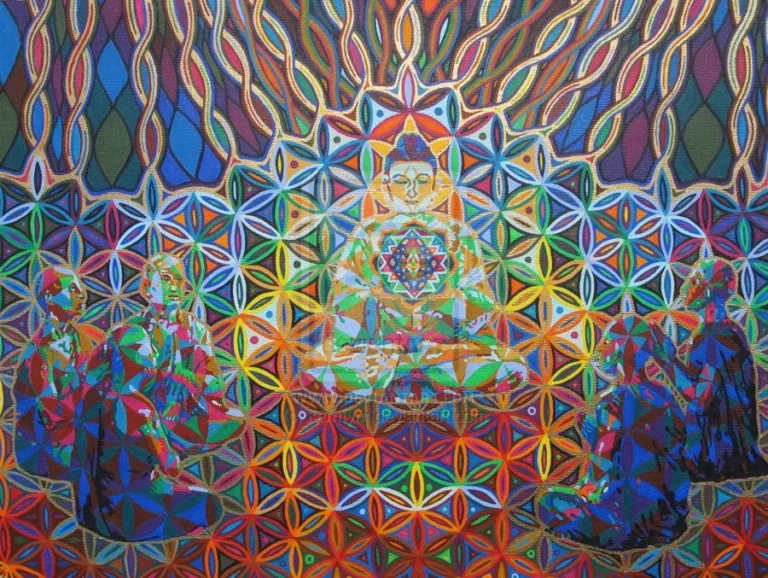
LSD has also helped in the formation of the visionary art genre where artist put down their experiences on canvas.

LSD has also been used to treat psychiatric patients in Switzerland until the 1930s, the videos of the testing of LSD on British military troops also makes a very interesting study. and I think the way forward is for thorough research to be put forth to challenge the system about the use and benefits of this potent psychoactive. Thankfully there already are people on the job!

Transforming Medicine: Psychedelic Science 2013 Mini-Documentary

“Don’t take LSD unless you are very well prepared, unless you are specifically prepared to go out of your mind. Don’t take it unless you have someone that’s very experienced with you to guide you through it. And don’t take it unless you are ready to have your perspective on yourself and your life radically changed, because you’re gonna be a different person, and you should be ready to face this possibility.” ~ Timothy Leary.

Resources:

The Multidisciplinary Association for Psychedelic Studies (MAPS)
Albert Hofmann’s book LSD my Problem Child
Bill Gates a Lsd User
Top 10 Greatest LSD Quotes
LSD And 60’s Music: What We Owe To It
20 Most Notable LSD Users of All Time
Hunter S. Thompson Quotes
In Loving Memory of John Cunningham Lilly, M.D.
Francis Crick discovering the double helix DNA structure
Hoffman bicycle day
Steve Jobs Image
Psychedelic Hunter Image

Understanding the Fibonacci Sequence and Golden Ratio

31

The Fibonacci Sequence

The Fibonacci sequence is possibly the most simple recurrence relation occurring in nature. It is 0,1,1,2,3,5,8,13,21,34,55,89, 144… each number equals the sum of the two numbers before it, and the difference of the two numbers succeeding it. It is an infinite sequence which goes on forever as it develops.

The Golden Ratio/Divine Ratio or Golden Mean

golden-ratio-fibonacci-sequenceThe quotient of any Fibonacci number and it’s predecessor approaches Phi, represented as ϕ (1.618), the Golden ratio. The Golden Ratio is best understood geometrically by the golden rectangle.

A rectangle unevenly divided resulting into one square and one rectangle, the square’s sides would have the ratio of 1:1, and the new rectangle would be exactly proportionate to the original rectangle – 1:1.618.

This iteration can continue both ways, infinitely. If you plot a quarter circle inside each of the squares as they reiterate, the golden spiral is formed. The golden spiral is possibly the most simple mathematic pattern that occurs in nature like shells of snails, sea shells, horns, flowers, plants. Numbers are only what we use to organize quantitative information.

golden ratio spiral galaxies
The Golden Ratio can be seen from a Chambered Nautilus to a Spiraling Galaxy

The Golden Ratio can be applied to any number of geometric forms including circles, triangles, pyramids, prisms, and polygons.

The golden ratio is formed by thirds within thirds, sixths, the connection between two and three, including every even and odd number itself. The ratio itself represents the transcendence of numbers, understanding our world is not numbers, but what numbers represent.

Through the spiral, the ratio illustrates how the numbers, all quantities, are quality. Eventually, all quality can be represented through quantity. Properties qualitative and quantitative are just labels of information, our gathered indisputable fact.

Fibonacci sequence in a sunflower
Sunflowers have a Golden Spiral seed arrangement. This provides a biological advantage because it maximizes the number of seeds that can be packed into a seed head.

If you graph any number system, eventually patterns appear. In mathematics, numbers and their patterns do not only continue infinitely linear, but in all directions. For example, considering infinite decimal expansion, even the shortest segments have an infinite amount of points.

Our universe and the numbers not only go on infinitely linear, but even it’s short segments have infinite points.

(A beautiful short film on Fibonacci sequence in Nature – ‘Nature by Numbers’)

The golden ratio is not the only mathematical pattern that reaches infinity, there are many other patterns as well that reach infinity. Knowing this, ask yourself, how could infinity occur twice? If something were to happen infinitely, how could it happen twice?

The answer is simple, infinity represents what is eternal, what is truly whole. For example, if infinity were to be used as a variable in mathematics like all other numbers, it would be denoted as 1∞, 2∞, 3∞, 4∞, etc.

The oneness of everything factual is what you know, what you perceive, what you are aware of, is all the universe looking at itself. This is the universe, even you are the universe, us and everything we know is all the same thing.

Since the numbers are everywhere, everything is a part of a pattern. Reflections of reflections, wheels within wheels. Life itself is a Fractal.

Image source

Phi Golden Ratio

Finding the Divine Within With Yoga

8
hatha yoga asana

Many start doing Yoga thinking it’s only some physical exercise, but as you progress, realisation dawns upon you that it is far more profound that that. Yoga is a path of self-evolution, of self-discovery that can guide us to the universal spirit and connect us with the divine being.

Like a quote from William Blake reads, “If the doors of perception were cleansed every thing would appear to man as it is, Infinite.”

Guiding us further on this path of discovering more about oneself with yoga, is Davide Ghiottone, an Italian yoga practitioner (since 1990) and teacher of Hatha and Ashtanga Yoga. We thought of asking him more on Yoga, breathing, his Gurus and his inspiration behind learning this ancient Indian science.

What got you interested in learning Yoga?

After I read the book on Hatha Yoga by Theos Bernard in 1989 awakened my curiosity, and it was my first book on the subject. Seeing the poses sparked a burning fire in me of learning the great skill to do those asanas. My natural flexibility and practice of karate and Jujitsu also supported in practicing yoga.

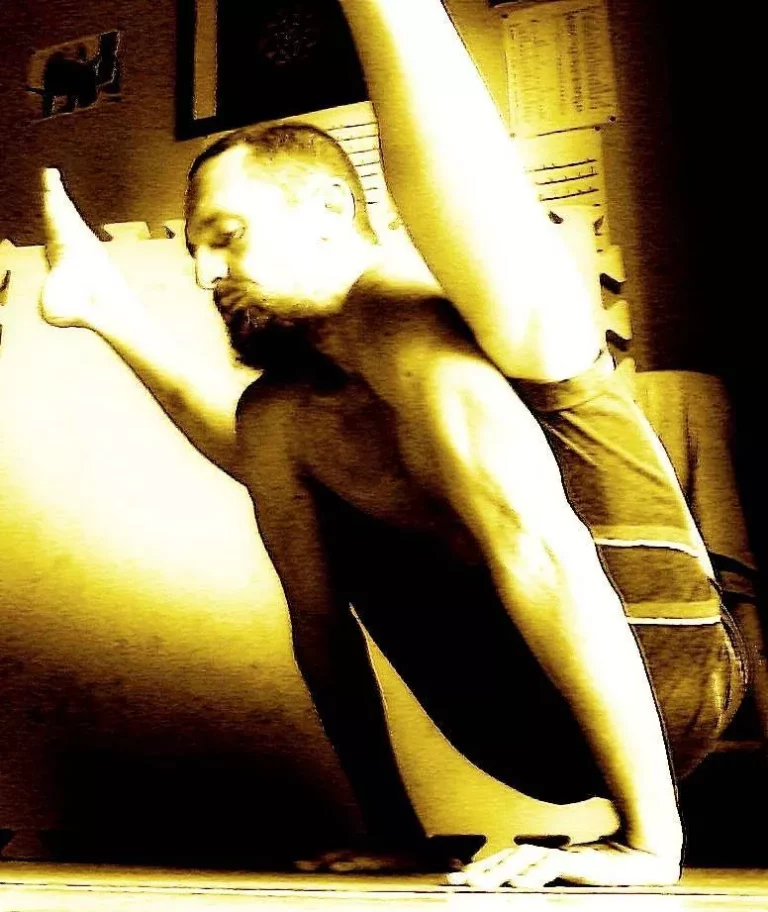
karandavàsana asana
Karandavàsana asana

How would you define Yoga?

Yoga is a science for discovering of what we really are. To know this, we must begin to practice yoga in all its form. There are many ways – Bhakti Yoga – the path of devotion, because without devotion to our body, our mind, our spirit or for all that we desire, there is no life. At first, the devotion is only for our health or for our benefits, but in time we develop real devotion for the supreme mind or spirit and then begin doing Bhakti.

There is Jnana yoga or path of knowledge, because without knowledge of what we are, there is no yoga. To begin, we have to know what is this consciousness, this mind, body, and the universe. As we delve deeper, we get better understanding of the Supreme Spirit or Shiva or the Supreme Consciousness, that is our only and real support of life and breath.

Another type is Raja yoga or yoga of the mind. In this we come in contact with our three minds: subconsciousness, consciousness and super-consciousness. On this path, which can be dangerous, we need a real master, the gùru, who will help us find a correct navigation to our goal.

Then there is the science of Ashtanga Yoga that composes 8 limbs of yoga, and Hatha yoga is the branch that study the physical aspect with àsanas and pranayama and breath being the link that connects the physical and spiritual.

mayuràsana-yoga-asana
Mayuràsana

When did you decide to focus on learning/practicing yoga? Where did you learn and which form?

My decision to focus on learning yoga matured with time. It started during my practice of meditation with the technique of Pratyahara that I learnt from my master Dada Muktatmananda of Ananda marga in 1990. Ananda Marga is the way of Ashtanga Yoga developed by the great master and guru Shri Anandamurti.

A simple technique called Isvara Pranidhana (which means that if we can completely surrender our individual ego identities to our own higher self, we will attain the identity of God) – yoga developed automatically in my spirit.

Scorpion Pose Vrschikasana
Vrschikasana or Scorpion Pose

While I started doing asanas in August 1990 with my master Maurilio Spagnoletti, a teacher of Integral yoga. He is a very skilled master and a true yogi that practices all the branches of Hatha yoga. I’ve learned from him the basic asanas and pranayama, and I practice this with Jujitsu.

Yoga is developing in me with each moment, in every breath that I take. In 2007, I began the Pattabhi Jois method of Ashtanga yoga with his great student Pierpaolo Altini. I do many stages of asanas with various masters, and now I comprehend that the master is always within me, in my intuition and knowledge of my body.

What difference has Yoga made in your life – spiritually, physically and mentally – in all these years?

The difference is evident in my lifestyle because from my meditation and contemplation, I’ve learned the reality of polarity and vibration in all that is in life. With time my life has changed, physically I’ve learned to balance, in terms of eating, sex, sleeping, working, and all movement that I do with my body.

I’ve also developed an agile, skilled, strong body with asana and pranayama, but in reality, body and mind are one and the same. My master taught me that our spirit is the higher mind the higher self, our middle self is our conscious mind that is our personality, and our low self is our body.

What is the importance of breathing in yoga?

Breath in yoga is the foundation for a good practice because breath is life, and without the coordination of breath and movement, called Vinyasa, there is no yoga. We must know that breath and thought have the same root in the supreme spirit, known as Prana; without Prana, there is no life.

Franz Bardon, the great teacher of Hermetics, taught about real breathing and the link between our breath, body and the astral matrix, he was a true yogi master. Few more great masters in this were Charles Leadbeater and Helena Blavatsky…

Do you chant mantras as well?

Mantras are words and the vibration of the words. Vibration is life, and frequency, our breath is a mantra. Let’s take the word ‘Love’; it can be a mantra if we repeat it with full consciousness and implant it in our subconscious mind.

Mantra in Sanskrit has the power in connection with those letters and how these letters vibrate and how much concentration of will and mind is behind them. We are always in connection with other human beings and beings in other plane of existence.

Yes, I chant a mantra every day because my recitation is always a prayer for humanity, for all beings, for all my brothers. We are all connected, like a computer to the net. The universal mind is the great net, and individual PCs are the individual minds of humans, animals, plants and all others being.

The repetition of a mantra connects us with the thought currant of the supreme spirit, but there are mantras with bad powers as well.

tittibhàsana firefly pose
Tittibhàsana or Firefly pose

How does one progress on this path of learning, in terms of asanas, pranayama?

One can progress on this path by purification of the emotional body with Yama (social ethics) and niyama (personal practices), purification of the physical body with àsanas, purification of the subtle body with Pranayama and Pratyahara, breath exercises and restriction of physical and subtle senses. Then move on to purification of the mind with Dharana and Dhyana (concentration and meditation).

In your opinion, what do you think of all the new forms of yoga – hot yoga, power yoga, etc., is it diluting the true essence of yoga?

There are many distortions of yoga practices – there are many styles in Hatha yoga, like Bikram yoga, Iyengar yoga, Power yoga, and Baptiste yoga. All of us can begin a new style, but it is only a method, and really yoga is not just physical àsanas, that’s only a branch of yoga.

Now many gurus are perverting this great science with their ego, but as I’ve always it is not important. What is really important is the increasing awareness of this spiritual science all over the world. At this time, the collective consciousness is in continual awakening, and yoga is playing its great part. Namastè to all!

Hope this article serves as an inspiration to seek a more balanced living. No better than learning and practicing this divine process of finding oneself and oneness!

Vipassana ~ A Path to Self Awareness

40

Vipassana is the way to see things as they really are; it is one of India’s most ancient techniques of meditation that was discovered by Gautama Buddha more than 2500 years.

He then taught Vipassana as a way to enlightenment and a universal remedy for day-to-day problems.

Vipassana saw a resurgence with S N Goenka, who started teaching others in 1969 after learning Vipassana. This has led to many Vipassana institutions worldwide that offer the 10-day course free of cost.

Vipassana is a technique that will eradicate suffering, it is a method of mental purification which allows one to face life’s tensions and problems in a calm, balanced way. The path of Vipassana is not easy, many do not complete it.

The Origin and Spread of Vipassana:

I went through part of this video which shows how Buddha gained enlightenment through Vipassana, how it changed him and how he started teaching people Vipassana to help them get rid of their earthly problems.

The video has nice images for each step of the journey and although the message of Vipassana to enlightenment may be pushed in a little too often.

Doing Time, Doing Vipassana:

Doing Time, Doing Vipassana is a full length documentary that talks about how Vipassana was introduced into the Indian prison system and the positive effect it had not only on the prisoners but even improved the interactions between the jail wardens, prisoners and their families.

It also includes the story of how Kiran Bedi, the former Inspector General of Prisons in New Delhi, India, strove to transform the notorious Tihar Prison, the largest complex of prisons in South Asia, and turn it into an oasis of peace. One very interesting part is when a murderer of three people, whose heart is filled with vengeance and is waiting to get out of prison to kill his enemies, undergoes a transformation through Vipassana and ends up filled with compassion. He even calls up the family of the people who he murdered to ask for their forgiveness.

The Dhamma Brothers:

Here’s a documentary film about a group of prison inmates who participate in a 10-day Vipassana retreat at the Donaldson Correctional Facility in Alabama. The film asks “is it possible for these men, some of whom have committed horrendous crimes, to change?”

The Dhamma Brothers tells a dramatic tale of human potential and transformation as it closely follows and documents the stories of the prison inmates as they enter into this arduous and intensive program.

Vipassana Experience:

Here’s one of my friend’s Amit Ayre’s Vipassana experience, “It started off really well. Excited to learn something new on day 1-2. By Day 4, I was done. Felt like I was wasting my holidays because of boredom. By day 5 morning, mind was made up and I was all set to quit. But then something happened. I spoke to the Guruji, who asked me to give it another day. I did. That was the day we started learning the Vipassana technique of meditation. Day 6 onwards, the actual journey started for me.

Vipassana meditation

It was wonderful after that, I started feeling the vibrations as we progressed. At one point, I felt they were mixing something in my food because of the experience, the vibrations and all that was surreal. Something I could not have imagined possible without psychedelics.

The best part of the day was the discourse where they played a pre-recorded message from S. N. Goenka, it was insane because he had an explanation for whatever was happening with me throughout the day. Everything we did throughout the day and why we did what we did as well as a lot of knowledge about the inner workings of your mind.

On day 10 we started talking and sharing experiences, it was simply wonderful, to add to that, it was also a full moon night. We were done with collecting all the new thoughts and new ideas. I spent that night under the stars, reading up, making notes, questions to ask etc. Another perk was the ability to connect with some incredibly awesome people, it was like Amit 2.0.”

There are hundreds of other Vipassana experiences online and on Youtube. If you are interested in doing a Vipassana course, you can apply for a scheduled course here

The Vipassana Course:

People who apply for the course have a strict code of conduct to follow for those ten days. They can’t have any connection with the outside world, all electronic devices are given to the management for this period. They have to maintain silence most of the time, simple vegetarian meals are provided, and neither can one write or read.

No physical contact with the same or opposite sex are permitted and perhaps the most important is to declare that you are willing to comply fully with the teachers guidance and instruction during the course.

Apart from that you have to abstain from killing any being, stealing, all sexual activity, telling lies and all intoxicants. If you are a returning student or have done a course earlier then you have three more rules, abstain from eating after midday, sensual entertainment and bodily decorations and from using high or luxurious beds.

[notification type=”default”]The daily Vipassana course time table is as follows ~

[two]4:00 am[/two] [two_last]Morning wake-up bell[/two_last]
[two]4:30-6:30 am[/two] [two_last]Meditate in the hall or in your room[/two_last]
[two]6:30-8:00 am[/two] [two_last]Breakfast break[/two_last]
[two]8:00-9:00 am[/two] [two_last]Group meditation in the hall[/two_last]
[two]9:00-11:00 am[/two] [two_last]Meditate in the hall or in your room according to the teacher’s instructions[/two_last]
[two]11:00-12:00 noon[/two] [two_last]Lunch break[/two_last]
[two]12noon-1:00 pm[/two] [two_last]Rest and interviews with the teacher[/two_last]
[two]1:00-2:30 pm[/two] [two_last]Meditate in the hall or in your room[/two_last]
[two]2:30-3:30 pm [/two] [two_last]Group meditation in the hall[/two_last]
[two]3:30-5:00 pm[/two] [two_last]Meditate in the hall or in your own room according to the teacher’s instructions[/two_last]
[two]5:00-6:00 pm[/two] [two_last]Tea break[/two_last]
[two]6:00-7:00 pm[/two] [two_last]Group meditation in the hall[/two_last]
[two]7:00-8:15 pm[/two] [two_last]Teacher’s Discourse in the hall[/two_last]
[two]8:15-9:00 pm [/two] [two_last]Group meditation in the hall[/two_last]
[two]9:00-9:30 pm[/two] [two_last]Question time in the hall[/two_last]
[two]9:30 pm[/two] [two_last]Retire to your own room–Lights out[/two_last][/notification]

Resources:
Dhamma
Vipassana Image

Pirahã, an Indigenous Tribe Living in the Now

20

I recently came across an indigenous tribe of the Brazilian Amazon, the Pirahã, and they captured my attention. The Pirahãs have a very basic, virtually non-existent numeric system that is not really based on numbers, but uses words to describe quantity.

When you have a tribe or civilization that doesn’t count, it kind of automatically becomes interesting, as it perhaps could lead to a system of more giving and sharing?

Don’t let the lack of numbers or one of the simplest languages in the world draw you away from how capable the Pirahãs are. Their language allows them to have conversations with each other just how we do and even whistle their language to communicate while hunting.

They are talented enough to walk into the forest empty-handed, without clothes, weapons or tools and come back three days later with baskets of fruits, nuts and a small game.

Living in the Amazon, they have mastered the techniques of adapting to their ecosystem, how to avoid animals and even the location and use of important plants. But one of the parts that got me interested in the Pirahãs is how rare it is to come across a tribe that doesn’t believe in God!

piraha_number_table

The Pirahã call themselves the Hi’aiti’ihi, roughly translated as ‘the straight ones.’ So what happens when a Christian missionary is on a mission to learn their language to translate the Bible and lead them to God?

Daniel Everette in his book “Don’t Sleep, The are Snakes” talks about how he went into the Amazon with his wife and family with the job of learning the Pirahã language and translating the Bible. What happens next is fascinating, hear it from Daniel himself –

After spending years with the Pirahã, Daniel ends up being influenced by the tribe that lives in the now. He looses his faith in Christianity, becomes an atheist and adopts more than he ever imagined from the Pirahã way of life.

Unlike most religions and tribes the Pirahã don’t appear to have a creation myth explaining existence nor do they have the concept of time, which enables them to live more in the now. When asked more about their beliefs, they simply reply, “Everything is the same, things always are.”

Isn’t the Pirahã tribe fascinating? As per a 2010 census there are 420 members left, my thoughts and love go to all the Amazonian tribes that are being displaced to create dams for hydro-projects when one can harvest the sun’s energy.

I believe indigenous cultures and tribes should be treated with for more respect as they have mastered the way and hold far more knowledge when it comes to living in oneness with our natural ecosystem and themselves.

Shouldn’t they be allowed to live the life they have been living for centuries if they wish to without being displaced?

Resources:

What Happens When a Language Has No Numbers?
Culture, Not Biology, Shapes Language
The Pirahã Controversy: Numbers
Brazil’s Pirahã Tribe: Living without Numbers or Time
Pirahã People