Home Blog Page 241

Socially Acceptable Samsara: 4 Examples of Liminality & its Celebration of the Cycles of Life

1

“During a ritual’s liminal stage, participants “stand at the threshold” between their previous way of structuring their identity, time, or community, and a new way, which the ritual establishes.” Wikipedia’s Definition of Liminality

Festivals and Celebrations

shaman-of-the-liminal

Trickster; Shaman of the Liminal

Small scale rites of passage, most typically of initiation from adolescence into adulthood; Bar Mitzvahs, graduations, weddings, and hundreds of rites of passage and separation, commonly ritualize the cycles of life and represent moments of liminality that most humans at some time or another experience.

This was what inspired Arnold van Gennep to write his work Rites de Passage in 1909, coining the phrase and instigating a whole exploration into a fascination on the subject up into the present day.

These include various stages including ‘preliminal/separation’ rites or a metaphorical death of old habits and ways of functioning where the individual or group stand wavering at the threshold as the fool might at the edge of the cliff.

The ‘liminal/transition rites’ then undertake the body of the ritual. Walking up the aisle for example; reading the vows, sharing a kiss, throwing the confetti… in other words the gradual shift from one mode of being into another.

And finally ‘postliminal/incorporation rites’ where the icing is laid on the cake and the individual or group are ejected back into society in their new form.

Sudden Traumatic events

A bold and life-giving shock of traumatic events inspires intense moments of liminality where the individual literally may awaken from the sleep their life had amounted to. When grounded to a halt the individual, in their fight-or-flight reaction therefore has a wonderful opportunity laid at their feet – be shaken to the existential core and be reborn… or not.

Having said that, “According to Turner, all liminality must eventually dissolve, for it is a state of great intensity that cannot exist very long without some sort of structure to stabilize it”, so even when presented with such a traumatic event we may still return to stability and normality, though the event will have irrevocably advanced us.

Though liminality can be seen as a space in time that becomes anti-structure and anti-belief where groups operate outside their normal function. Upper and working classes mixing together on a pilgrimage where they’d normally avoid each other for example, or a ritual initiation where the usual rules to do with men and women conversing for example will be momentarily lifted.

The best example of this is probably where natural disaster or war occurs, being both a traumatic event and the following ‘Grand-Scale change’, where all social standing, wealth and ideological beliefs dissolve in the face of our purer humanity.

Grand-Scale Change

ritualprocessTo expand on the previous point, during liminality “social hierarchies may be reversed or temporarily dissolved, continuity of tradition may become uncertain, and future outcomes once taken for granted may be thrown into doubt. The dissolution of order during liminality creates a fluid, malleable situation that enables new institutions and customs to become established.”

Sounds good doesn’t it? Despite the possibility for positive re-jiggling and the re-distribution of power and wealth, liminality or revolutionary periods have been known to spawn meglomanics and some of the most famously dangerous historical figures known today.

Hilter, Stalin and Mussolini, when the collapse of order takes place people often put their trust into someone who seems to have got it together – a trickster – with no emotional ties to the situation and talented in imitation (exciting the crowd and projecting a charismatic persona) who is therefore most definitely not to be trusted and are steeped in the shadow side of the trickster.

These times of political instability are when these individuals usually rise to power… the results as we know can be genocide, famine and of course, war. Tricksters feed on those who (during periods of liminality) fall under mimetic behaviour (behaving, well… like sheep) and are vulnerable as they are less likely to behave rationally, giving way to hysteria and falling prey to the first ‘leader’ who comes along.

Religious way of life

To constantly live on the edge or off grid, as a monk or hermit or as a traveler could be seen as living in a constant state of liminality, or at least attempting to be. Gypsies have honoured this way of life for centuries and heralding liminality as a religious pilgrimage and way of life seems to earn the seeker great wisdom as well as a bad name.86

The individual process of self-realization can be seen as a liminal state; where we withdraw from society to break down the ego and its persona in order to regain a more authentic mode of being. Constantly tripping oneself up as soon as we get comfortable, inviting adventure and consistently challenging ourselves to step beyond the unknown as a way to evolve –

“Individuation can be seen as a “movement through liminal space and time, from disorientation to integration….What takes place in the dark phase of liminality is a process of breaking down…in the interest of “making whole” one’s meaning, purpose and sense of relatedness once more'”. As an archetypal figure, “the trickster is a symbol of the liminal state itself, and of its permanent accessibility as a source of recreative power.”

Image Source

Shaman of the Liminal

Three Ideas of How To Bring a Sense of Community Into Your Life

“We cannot seek achievement for ourselves and forget about progress and prosperity for our community… Our ambitions must be broad enough to include the aspirations and needs of others, for their sakes and for our own.” ~ Cesar Chavez

As sociable creatures, in this consumerist greed-driven world where people live in boxes picket-fenced up with high walls and no eye contact, our sense of community has very much fallen by the wayside.

In comparison to how it was for our grandparents say, fifty years ago, as the pace of life reaches ridiculous heights and people are waking up in the morning and asking themselves – really… what IS the point of all this, we find ourselves taking a step back, walking a little slower and attempting to bring a sense of community back into our lives.

Go To Church

No wait, keep reading – for those of you anti Christians and Catholics out there I’ll say right away that this is just an example.

I’m not pumping a specific religion or trying to convert anyone, but I’ve found, especially since starting a family, that what organized religion offers and did offer our grandparents, was exactly what many city-goers and the new generation are really yearning for… a sense of community.

The church or group from any other faith, though sometimes pushy and likely to trigger all sorts of cringe worthy memories from our childhoods if we were brought up in such an environment, does do an amazing job at pulling together the threads that have been sewn in a community but never quite finished off.

Summer fayres, pantomimes, village fetes, mother and toddler schemes, the list goes on. Not only does the church bring people together geographically but, even if you don’t have full and devoted faith they are always welcome to new faces and most are genuinely eager to help.

For those of us who feel depressed, lonely and isolated sometimes, just attending on event a week can really make a transformation and show us that there are people out there who really care, even if those we feel should show more of an interest, don’t.

Part of the problem with society at present seems to be that people are unable to admit it and seek out help when they need it. It’s probably the first time since the dark ages that people have become so separate, something that is incredibly unnatural and unable to sustain for much longer. It’s that simple, we need each other.

So, if you are able to find a local church or tap into some of the events they are involved in, then get yourself down there.

Go On Retreats

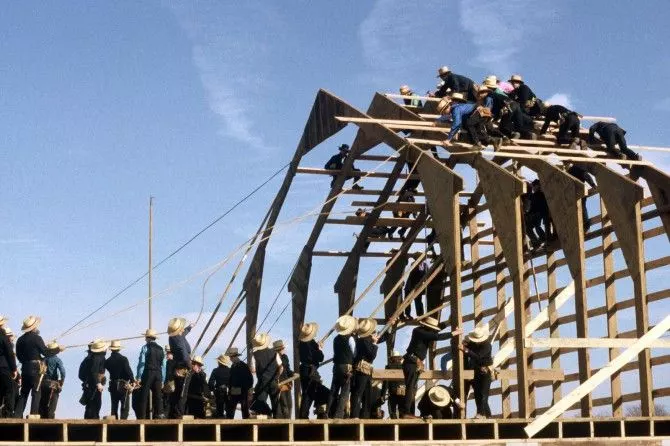
Pamish_barnraising_community_livingerhaps the most expensive of the three, retreats can be a huge opportunity to work alongside those on your level and many include mornings of yoga and meditation to really get your communal spirits up.

Praying or working together especially seems to be a great way to bond and clean ourselves up at the same time, like the Amish communities we can get back to the basics of being interdependent and doing things for each other.

It may be hardwork at times, but if everything in nature serves something else then so should we. It is biodiversity and humans at their best. It is karma yoga and attracting the sort of treatments from fellow human beings that you deserve. They also happen to be great fun and can give you ideas for your own community.

If you can’t afford these sorts of retreats, check out any meditation centre such as Vipassana or Buddhist centres and you should find ones that operate on donations so you pay what you can afford. Failing that and if you really want to get stuck in then check out WWOOF and workaway.org for voluntary programmes that will provide full bed and board in exchange for four to five hours of easy but most likely quite physical work.

Set Up Your Own Community

commune_portHuge task I know, but if this is your long-term goal then get started! A lot of people who’ve done it or built their own homes offer work experience or courses. Then there’s the huge amount of information in the Internet as well as facebook groups on going off grid.

Why not start small and work your way up? Enroll in one of those courses or invest in a book on the subject then get cracking; forage, make your own shampoo and deodorant, start collecting rainwater and growing your own veg.

Where the community aspect of all this comes in is that getting stuck in no matter how small scale it is at first will attract the right sort of people – your ‘tribe’ – and lead to bigger plans of building and running it together.

How would you organize your day? With morning meditation and a spiritual approach? Or with more emphasis on sustainability with self sufficiency and communal eating? Go on workaway and get your own volunteers to make your dream come true.

If you have some savings this will be especially viable, but just building an allotment or a small cabin you stay in at weekend will be enough to get started with.

Start a gardening/Yoga appreciation/chanting/same sex healing/singing or counseling group and go from there. A lot of these things cost an arm and a leg to attend and are run by experts in their field, why not lower the barriers and just go for it, admitting you’re tracing baby steps and get others involved in the leadership to ensure it happens.

You’d be surprised how far a little flyer in your local greengrocer’s shop window will go if you honestly state your desires and see if there’s anyone else interested. All you can do is try it and see what happens.

Any more ideas for ways to bring a sense of community into your life? Please comment below.

Image Source
Amish
Hug
Commune

Three Ways to Overcome Negative Emotions

6

“Balance cannot be known unless you taste both extremes. You will dabble, struggle, even suffer until you muster up the the extraordinary courage necessary for embracing all of your humanity.” ~ Amy Larson

Two words that any spiritual seeker is inundated with, no matter what school of thought they are a part of, are “acceptance” and “love”.

It doesn’t really matter which spiritual practice we are following or which teacher we are listening to.

We are constantly told to accept ourselves as we are, accept others as they are, and unconditionally love everything, including all of our “negative” emotions.

And as simple as many spiritual teachers make it sound, the actual concept of acceptance and love can actually be not only more confusing than it seems, but harder than it looks.

How many times on your journey have you told yourself that you can accept that you are angry, let’s say, attempted to love it (in hope of making it go away), and nothing happened?

It might have gone for about 5 minutes while you distracted yourself with something else, or tried to make yourself feel how you didn’t really feel, only to pop back up again in your mind the minute your mind started to re-tell the story that was the catalyst for the emotion in the first place.

The problem with this method of dealing with emotions is that we are denying ourselves one very important aspect of our journey.

This one small step that we fail to realize actually becomes the key to liberation, safety in our own body, confidence in our lives, and truly feeling as though as we are doing everything “right” in our spiritual quest.

Embrace your Emotions

The step I am speaking of, is embracing our humanness, loving our innocence, and eventually, completely surrendering to the fact that our ego-mind is not designed to truly love anything unconditionally.

At the point of this complete realization of helplessness, we open ourselves up to a higher intelligence and presence to work through us and do it for us rather than trying to force ourselves to feel in a manner that we don’t really feel, or accept something that we don’t really know how to accept.

negativeimage2“Love is the absence of judgment.” ~ Dalai Lama

Our minds are not designed to know how to stop judging. This is simply the fact of the matter. The mind is constantly labeling things as good or bad, right or wrong. As many of us unknowingly let spirituality trickle in to our ego, we start to form our perspective around the way we think we “should” or “shouldn’t’ be.

Judge Less, Accept More

We “should” be forgiving. We “shouldn’t” be angry. We “should” be loving. We “shouldn’t” be critical. We “should” be generous. We “shouldn’t” be jealous. You get the point. It seems the more we find teachings that we resonate with, the further away from our own humanness we go.

As soon as a perceived “negative” emotion pops up, we start judging ourselves as “not there yet”, “not enlightened enough yet”, “still attracting negativity to me because there must be something I”m doing wrong.”

At this point, we begin to try and deny our own innocent hearts as they feel a natural emotion pertaining to a circumstance.

What we inadvertently are telling our innocent hearts is, “How UN-spiritual of you to feel angry about this. You’re supposed to love everything and accept everyone as they are, so you don’t get to feel angry about this. You must accept it and love it, like the good spiritual seeker you are.”

And as you can probably guess by now, this doesn’t work. This is actually the perfect recipe for resentments to form.

We try and force ourselves to accept things our minds were never designed to know how to accept, to forgive people our minds have no clue how to begin forgiving, and to love things and emotions that let’s face it, we DON’T love, and as a result, we begin to cultivate a million resentments towards people, places and things in our lives that we feel are constantly forcing us to deny our own authenticity.

Be Honest with Yourself

When we get to the point where we are so honest with ourselves that we can admit to ourselves, and the universe that we, in fact, don’t know how to love that person or that thing unconditionally.

We don’t know how to forgive someone for an act we still believe is unforgivable, or we don’t know how to feel grateful for the things in our lives because things don’t really seem that great from where we are standing, we come to our last and most transformational option. Admitting helplessness.

To the ego this sounds terrifying. And rightfully so, to finally admit that only a force greater than ourselves will be able to come in and save the day for us, means that all the spiritual busy-work we have grown accustomed to partaking in may actually be starting to work against us instead of for us.

If we can’t feel completely free and comfortable to feel however we naturally feel about something, then what exactly is the point?

Over time, as we embrace our emotions and feel ok to feel however we are inclined to feel, and also are able to freely admit that we don’t know how to just “get over it”, we will notice that naturally a force greater than ourselves begins to do all these things on our behalf.

Soon things that we thought we would never get over become something in the distant past that we don’t even think about, and people that used to annoy or frustrate us no longer are bringing up any sort of reaction in us.

“If you change the way you look at things, the things you look at change.” ~ Wayne Dyer

So everything is only arising in our reality only to be accepted and loved. That also means accepting and loving the part of ourselves that has no idea how to accept and love a certain emotion. Whatever your spiritual practice is, whether it be meditating, praying, writing, etc… we can affirm to ourselves and our higher power that we are having a particular emotion and we don’t know how to resolve it.

negativeimage3At this point we can ask our higher power to do it on our behalf.

What a shift in energy when we can stop “trying” so hard to get rid of things that our minds were never going to be able to get rid of and instead hand over all the hard work and effort to the only thing that can in fact help us to dissolve these emotions.

As time passes the more we stop trying to feel and act how we aren’t naturally feeling, we notice that all emotions and feelings are welcomed in as a gift, even the “unpleasant” ones.

It can only arise because it is the next part of our own humanity that is wanting to be acknowledged and honored.

As soon as every part of our own heart feels “heard”, the sooner we feel allowed to be and feel however we feel inclined to without having to judge ourselves as “not spiritual enough”. Which ironically, becomes the one thing that moves us through “spiritual ego” and on to a completely liberated existence.

Image Source

Darkness and light
Love and Pain
Emotional pain

Nine Frida Kahlo Quotes to Inspire Your Innate Sense of Creativity

6

Frida Kahlo, like many other artists and painters made a unique body of work around her experiences of intense pain and suffering; both in reaction to her crippled body following a bus accident and her tumultuous relationship with mentor and fellow painter Diego Rivera.

She wore her suffering with great dignity and an unswaying honesty, revealing – much like many other female self-portrait artists and photographers of the 20th century – the vulnerability and innocence of true femininity, giving her a huge amount of credibility and, well, integrity.

Frida Kahlo quotes

Her painting style though known as primitive lends itself to this honesty, and it is because of this unique exploration of such human frailty that she, in her paintings and photographs as well as her quotes, probably has a huge amount to teach us on the art of mortality.

Here are nine Frida Kahlo quotes to inspire you on your journey.

1) “I don’t paint dreams or nightmares, I paint my own reality”

Thoroughly insisting that she was NOT a surrealist, Kahlo preferred it to be known that she lived in this world of operations and dissected organs. Perhaps she also refers to her colorful inner world, one that we all have.

If one of the meanings of life is to get to know oneself then Kahlo showed us how to do it in style. Perhaps we don’t all have the identity of lustful monkeys and Mexican folk lore but we may be surprised at how rich our inner world is if we cared to look a little closer.

2) “I used to think I was the strangest person in the world but then I thought there are so many people in the world, there must be someone just like me who feels bizarre and flawed in the same ways I do. I would imagine her, and imagine that she must be out there thinking of me too. Well, I hope that if you are out there and read this and know that, yes, it’s true I’m here, and I’m just as strange as you.”

We are all in the same boat, there is no real distinction between us, we are all One. We all might imagine there’s something ‘wrong’ with us at some time or another in our lifetimes.

The only barrier between us (and a necessary one at that for some aspects of life) is this realization of self and other. Through art and awareness we can learn that we are not alone and there is no distinction. There never was any.

frida_kahlo_le_due_frida

3) “I drank to drown my sorrows, but the damned things learned how to swim.”

Suppression of our emotions will never work. They’ll always find a way to swim back to the surface, perhaps in an uglier and more threatening form than they sunk down with.

It seems the more we suppress and ignore, the more they come back – it’s the law of karma. A problem will evolve and become grittier and more unforgiving the longer you leave it.

4) “Nothing is worth more than laughter. It is strength to laugh and to abandon oneself, to be light. Tragedy is the most ridiculous thing.”

Tragedy IS ridiculous, at least that’s how it seems when you can forget to be serious and just laugh. Having said that getting to that point can often feel enormously difficult. The less seriously we take ourselves in the first place the better.

Surrounding ourselves with ‘lightness’; diet, media intake, company, the easier this will be. Relaxing and letting go will be the best investment you have ever made. Remember there are homeless orphans with nothing to eat sitting in the sun right now and having a good laugh. If they can do it, so can you.

5) “Nothing is absolute. Everything changes, everything moves, everything revolves, everything flies and goes away.”

This too shall pass. The ever present riddle of impermanence. How to get one’s head around this and swim in its glorious lesson every second of the day. This is a gift from the artist but a damning of the depressed.

With depression, a ‘low’ we feel like it will never end. Being the artist, we create with what we have, even if it seems depressing. Our suffering and the concave feeling we are experiencing has promise too. It can be enjoyed. No kidding.

6) “I wish I could do whatever I liked behind the curtain of “madness”. Then: I’d arrange flowers, all day long, I’d paint; pain, love and tenderness, I would laugh as much as I feel like at the stupidity of others, and they would all say: “Poor thing, she’s crazy!” (Above all I would laugh at my own stupidity.) I would build my world which while I lived, would be in agreement with all the worlds. The day, or the hour, or the minute that I lived would be mine and everyone else’s – my madness would not be an escape from “reality”.”

Frida Kahlo1

Madness. Society’s agreement on what is considered normality. Perhaps reality really is, in a solipsistic fashion, all in our minds. To be considered crazy is to be left alone. No expectations, no responsibilities, no need to show up and perform.

‘In agreement with all the worlds’… inhabiting the agreed norm, our own multitudinous realities and perhaps piercing the many layers of world upon world; that which lends itself to creativity, the memes that float through the air and attach themselves to us in the form of a great idea.

The start of a new life or the beginning of a more positive way of being. The reason for being; love and creativity.

7) “I want to be inside your darkest everything”

Perhaps we like suffering – do we chose to experience it? It’s definitely harder to face the day and suck up all that comes with it without feeling sorry for ourselves. It seems that this is (negatively) what we use relationships for.

Mirroring self-hatred and our deepest wells of sadness. Becoming inert and self-destructive. Relationships are so promising and there to help, yet many a time we need to fall into the trap of trying to project our egos onto the other and hoping that they’ll save us.

A mature and spiritually healthy relationship comes from two individuals operating on their own level, interdependent, loving, and sharply reflective.

8) “Pain, pleasure and death are no more than a process for existence. The revolutionary struggle in this process is a doorway open to intelligence”

In three states of being the trick is not to submerge yourself in it but become the witness. Let them wash over you and then learn from them. Don’t try to stop the pain happening again but welcome it.

Don’t try to stop the pleasure from passing but instead wave it goodbye and don’t try to run from death because it’s your best friend.

Perhaps the worst possible thing in life is stagnation; the opposite of impermanence when nothing moves but the stink as it hits the nostrils.

9) “I paint self-portraits because I am so often alone, because I am the person I know best.”

How can we ever truly know anyone else but ourselves? To be alone is an opportunity. When you’re in the crowd you never learn. You never become anything new. OK so it’s fun, life moves at a pace. But it becomes so routine, so predictable.

As Frida Kahlo has graciously proved, there’s no fountain so nurturing as our own well of self; our inner world, own personal suffering and heart-broken moments are the things we will look back on and celebrate.

Image Source

Frida Kahlo
Heart
Diego

How (and why) to Transform Ecocide into Deicide

“We are embedded in the natural world. We evolved as social creatures in this natural world. We require clean water to drink, or we die. We require clean air to breathe, or we die. We require food, or we die. We require love, affection, social contact in order to become our full selves. It is part of our evolutionary legacy as social creatures. Anything that helps us to understand all of this is natural: Any ritual, artifact, process, action is natural, to the degree that it reinforces our understanding of our connection with the natural world, and any ritual, artifact, process, and action is unnatural, to the degree that it does not” ~ Derrick Jensen

Deicide: Destruction or killing of a god.
Ecocide: Destruction of the environment.

I know you’re comfortable with the unhealthy, unsustainable system that has been erected around you without your consent. I know the corrupt system has been keeping you fat and happy with the illusion of security for most of your life. And I know it’s scary for you to admit the corrupt nature of human governance hitherto. But it is imperative that you do so.

It is imperative that you question the authority that upholds it to the nth degree. It is extremely important that you become aware of how the absolute power carried by the powers-that-be is absolutely corrupt. It is destroying the health of the planet.

It is destroying your health. It is destroying the health of your children and it is indirectly destroying the health of your grandchildren. It is nothing short of mass ecocide.

Like Aldo Leopold warned, “A thing is right when it tends to preserve the integrity, stability, and beauty of the biotic community. It is wrong when it tends otherwise.”

deicide

Granted, you cannot control the system. You cannot control the powers-that-be. You cannot control other people and their actions or beliefs. But you can control yourself. You can control your reaction to corruption. You can destroy the so called “gods” that have kept you leashed to a prisoner’s lifestyle.

Whether your “god” is parochial, monetary, political, or even philosophical, “If you meet Buddha on the road, kill him.” Kill him metaphorically, with hard love. Look that b**tard square in the eye and declare, “You do not own me. You do not decide my path. You’re a cartoon in the brain, at best. And the only thing that matters is the path, is the journey being the thing.”

And then go about proving it. Just remember: there will always be an environment your journey must go through. And in order to keep your sacred journey “the thing,” you must, at least, attempt to keep that environment healthy enough to maneuver through.

Being ecocidal is no way to travel. It is, in fact, the opposite of good travel, as it fundamentally defeats the purpose of “traveling well.” If you destroy the environment, eventually there won’t be an environment to travel through. So it most definitely goes.

Like Aldo Leopold said, “The land is not a commodity that belongs to us; it’s a community to which we belong.”

There is an indirect link between deification and ecocide: deification attempts to pigeonhole everything into one basket, leaving people to cling to outdated baskets for dear life. All-too-serious in their sloth, those who deify things bolt the horizon and bar the sky, closing off cosmos and limiting the far-reaching capabilities of the human soul.

The sad tangle of their bones buckle beneath the horror of a judgmental god pressing in like cruel cancer. So they cling to things all the harder: ideas and ways-of-being. They hoard things: land and water. They stockpile at the expense of others: money and wealth. They reduce themselves to fear-filled pawns on a precarious chessboard built by unsustainable and corrupt men.

Deicide, on the other hand, opens up the universe. It shatters mental paradigms. It flattens boxes. It kicks “the doors of perception” wide open. It frees us to imagine new imaginings, and it prevents us from living fear-filled lives.

Courage abounds. Love abounds. And the True God, Infinite Impermanence, reveals herself, laughing wholeheartedly –ovaries to marrow– at the “seriousness” of it all, at the existential angst, at the spiritual conundrum, at the woe-is-me quantum enigma. She whispers warningly to us, between deep belly-laughs, “Kill me! It’s the only way to prevent the cartoon in the brain from tricking you into a fixed state.”

lorax

As human beings, torn between spirit and flesh, we are daily faced with a Faustian bargain: to give up the spiritual-science of heart & soul for the pseudo-science of wealth & power.

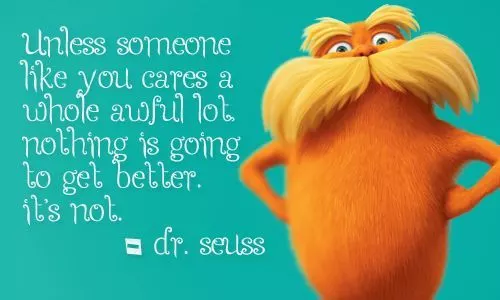
In an age marked by rampant genocide and epidemic ecocide, we’re long-past due to renegotiate the terms of this unsustainable and untenable bargain. Like the Once-ler says to the child in The Lorax, “But now, now that you’re here, the word of the Lorax seems perfectly clear, UNLESS someone like you cares a whole awful lot, nothing is going to get better. It’s not.”

The earth crisis is a spiritual crisis. Whether you’re spiritual or not, it doesn’t matter. The fact that everything is connected trumps your lack of awareness that such is the case.

As Wendell Berry said, “There are no unsacred places; there are only sacred places and desecrated places.”

As it stands, the human world is a desecrated place, a wasteland of monumental proportions.

And I know that cognitive dissonance is a cruel subconscious puppeteer, puppeteering you around like a fearful victim of a victimizing culture. But it’s your responsibility to recondition your own preconditioning. It’s your responsibility to get the “horse” of your life back in front of the “cart” of your life.

It’s your responsibility to balance yourself with your environment, lest your environment reject you, or worse, you destroy your environment.

As Eliezer Yudkowsky wrote, “You are personally responsible for becoming more ethical than the society we grew up in.”

Rejecting conscience (just another flavor of cognitive dissonance) helps eliminate the tension of emotional conflict, but it’s no excuse. Such rejection just leads to an over-simplification of your inner-life, and morality is shrunk to simply “obeying orders.”

Like Louis G. Herman wrote, “In a culture where the overriding moral imperative has been narrowed to doing one’s job, earning a living, and maximizing profits, there is no sense of responsibility for one’s larger impact on society and nature. Ethics dwindles to an afterthought.”

Don’t allow your ethics, your morality, your sense of right and wrong, to dwindle to an afterthought. Make it forefront. Make it paramount. Make it an overriding principle. The best way to do that is to act out amorally, despite the immorality or morality of the times. And the most powerful amoral act, is an act of deicide.

Kill all gods! Money, The State, Yahweh, Allah, Buddha, Satan, The flying Spaghetti Monster; whoever, or whatever, claims to be an authority. Cut their non-existent heads off and nail them to the wall of your imagination, then throw all the darts of your courage at them until you hit the “bull’s eye.”

banksy

Burn their non-existent bodies in the crematorium of your imagination, then use their ashes to resurrect the Phoenix of your own heroism.

Let the ballyhoos and hullabaloos of fearful men sound in the hallways of your audacious courage. Let them quibble in their own self-righteousness. You have work to do. Their fear and vacillation should encourage you to be fearless and resolute in your spiritual robustness.

Topple all thrones. Kneecap all high-horses. Melt down all pedestals, especially the ones with “golden calves” on top. They only have meaning in your head anyway. Outside of your head, their meaning falls to zero. Their only “importance” lies within a social pseudo-contract that only you can decide to sign or not. Sometimes you have to decide every day whether or not to sign. Burn that goddamned contract in the fire of your courage. Nobody else can do it for you.

At the end of the day, you can lead a human to health, but you can’t make him/her healthy. Being healthy is a very real interdependent contract between you and your environment. One that you have no choice but to sign. Noncompliance itself is a signing toward an unhealthy, unsustainable mode of being in the world. Sign the contract between you and Mother Nature, between you and the interconnected universe, between you and the interdependent cosmos.

Burn the pseudo-contract handed down to you from unsustainable men claiming authority. The former contract is tenable and can lead to a healthy evolution for our species. The latter contract is untenable and can only lead to our destruction. Transform ecocide into deicide. Do it for your children. Do it for your grandchildren.

Like Thomas Berry said, “We will go into the future as a single sacred community, or we will all perish in the desert.”

Image source:

Ecocidal
Ecocide Album cover
The Lorax
Stop fighting over…